


































![Very Cool! Make Your Own Star Wars: Legion Imperial Agent & Officer | Review [7 Days Early Access]](https://images.beastsofwar.com/2025/12/Star-Wars-Imperial-Agent-_-Officer-coverimage-V3-225-127.jpg)


Unboxing: 1/72nd British Churchill Tank
January 13, 2015 by dignity


Justin and the living breathing tank encyclopedia that is John take a look at the 1/72nd scale British Churchill Tank from The Plastic Solider Company.
The Churchill MkIII is famous for getting the better of a German Tiger 1 during the preliminary phases of the Battle of Longstop Hill as part of A Squadron, 4 Troop of the 48th Royal Tank Regiment.
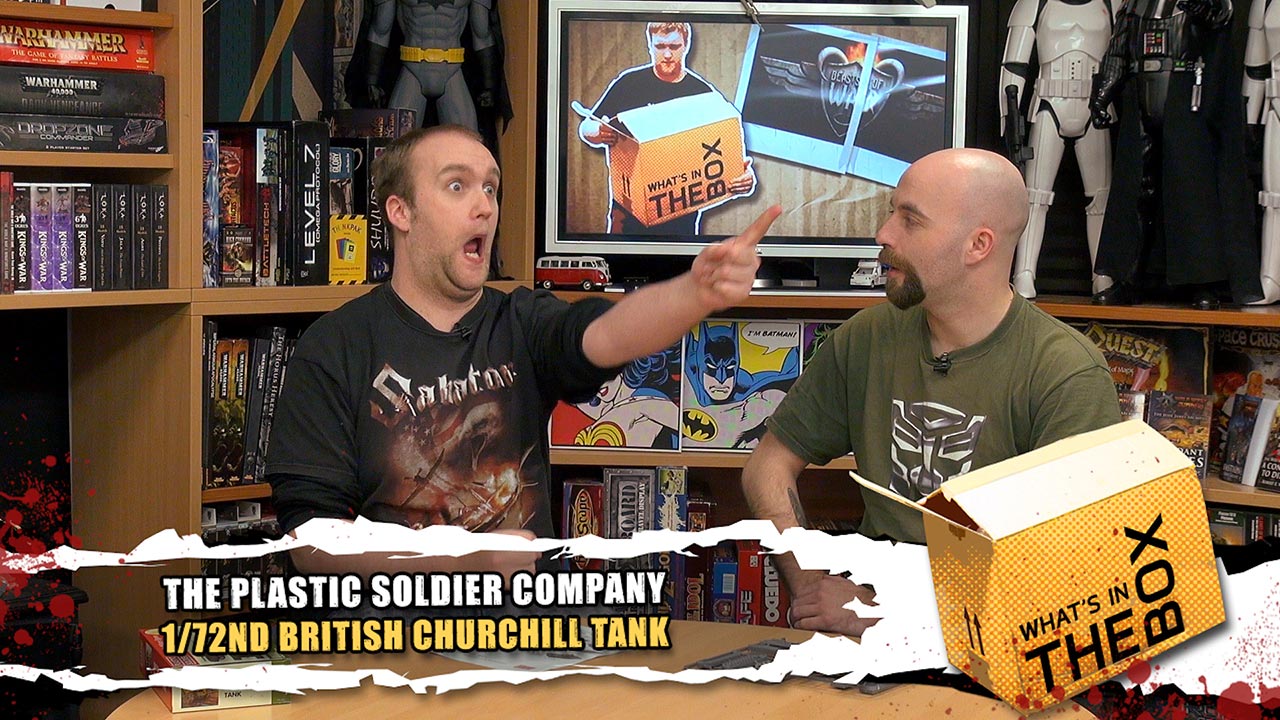
Tiger 131 was the first Tiger Tank captured by British/American forces and has recently used in film Fury.
John thinks the Churchill looks like the Thundercat's Lair, do you?









Not my scale , but nice looking kit . John , the Petard round weighted 40 lbs . The mortar barrel broke like a shotgun and was loaded from the bottom thru a sliding hatch over the bow gunner . A little kit bashing to model this type , hmm .The Churchill was really a throw back design , more WW I style with the high track run and a speed of about 15 mph ! It gave it a long footprint for weight distribution and great climbing ability . Also there was lots of room in the side sponsons for crew stowage , the ammo and in the engine compartment , fuel .
Might have to pick up some of these and do them up as AVREs. Built a 1/76 scale Churchill VII years ago and I can still remember gluing all the individual wheels on :'(
The rules from PSC/Ironfist are Battlegroup Kursk (& various supplements) and can be played with 20mm or 15mm scale forces.
I have the 15mm scale Churchills (among many other things).
Love it! I have a beautiful pre-painted Churchill75 from Forces of Valor, same scale. It’s one of the favourites of my collection.
I’ve got a set of the 15mm version, also from PSC. Those are 5 per box.
It’s pretty much the same kit with an added Mk III (welded) turret option, but scaled down a bit.
Went together very easily, and if you scratchbuild an extra gunner’s hatch you can make 2 swappable turrets for each tank.
That one’s an excellent buy for Flames of War. I’ve been tempted to get another one so I can field a Tank Squadron based on the ones operating (quite effectively) in Italy.
The Italian and North African campaigns were where these earlier Churchill marks proved their worth. It was difficult tank country there, but the Churchill’s low ground pressure and climbing ability allowed them to go where no-one expected tanks to go, sometimes to great effect.
The design was less effective in France, where the limited top speed was a serious weakness and their superior ability to cross rough ground wasn’t as useful.
Another notable role of the AVRE version was as a general engineering vehicle; they were used to carry assault bridges or fascines to bridge ditches etc.
After the versions you can build with this set came the Mk VII/VIII, which could be converted to the Crocodile flame-throwing version and generally was. This late version was the best-armoured tank in active service with the western Allies during the war (thicker armour than a Tiger I). The Crocodile in particular was devastating since it was a flame-thrower (already terrifying) mounted in a nigh invulnerable tank. Even if you blew up the armoured fuel trailer, you were still facing a tank with massive amounts of armour and the OQF 75mm, noted for its effective HE rounds.
nice looking tank I am surprised that you never mentioned the Germans thought that they were old tanks when they captured some when the Dieppe or Calais attack failed john.
John you will need an AVRE for Bolt Action and see what Justin can answer with in the arms race 😉
won’t be long before he’s got a Panther on the go I’d imagine haha – hate the damn things, my brother’s has a tendency to chew up my Cromwell’s as though they were made of paper…
If john and Justin start playing with big heavy tanks that toss around oversized, short-ranged mortar bombs . . . John’s AVRE might find itself up against a German “Sturmtiger” or “Sturmmorser.” 70 tons of armor, and a 380mm rocket-assisted mortar, baby. 🙂
Really nice video – a good mix of history, general chat and good looks at the kit. Also, very nice to be able to see the sprues as well as the finished kit!
Thanks for the mention, @johnlyons , but to be honest I had no idea how much the AVRE’s round weighed until a27cromwell let us know. 🙂 You’re the tech and tactics guru . . . I’ll do my best to keep up with the battlefield history.
I do know the range with that “dustbin” is extremely limited. They’d have to drive up pretty almost right in front the target before firing that “flying dustbin” at bunkers, buildings, emplacements, concrete blocks the Germans had poured in front of the Juno, Sword, and Gold beach exits, that kind of thing, as you say.
We saw one of these at Juno beach went we went to Normandy for the 70th Anniversary (26th Assault Squadron, Royal Engineers, attached to 7th Canadian Infantry Brigade) – right in front of Graye-sur-Mer. It landed at H-Hour on June 6, helped blow open the exits to Juno Beach, and was knocked out about 200 meters inland. Later, the family of one of the KIA crewmen donated funds to have their son’s tank preserved as a memorial.
I’m pretty sure the first use of these Churchills in general was at Dieppe of all places (Aug 42), where all 27 were knocked out of abandoned at that disastrous raid. Of course, these were the very early ones that still had all sorts of problems, and were so poor that the Germans scrapped them rather than press them into service (as they did with practically all salvageable Allied tanks).
A handful of them were tried out at the last battle of El Alamein (Nov 42), where they did very well. Later in Tunisia (April 43), it was a Churchill from 48th Tank Regiment that actually scored the lucky hit that disabled “Tiger 131” – the same “131” that now resides at Bovington Tank Museum and appeared in “Fury.”
I’ve got some photos of the Churchill AVRE and Crocodile flame variant (we saw this one at the Overlord Memorial Museum at Bayeux) posted in a new thread on the Historical Forum town square. 🙂
http://www.beastsofwar.com/groups/historical-games/forum/topic/churchill-avre-and-crocodile-photos/
Great video! I can’t wait to see one of these things painted. All t hat PSC detail is really going to catch dark washes and dry brush highlights very well.
Thanks for linking the thread @oriskany!
Dieppe I remember that it was a large harbour town that was attacked.
It was also a complete disaster with no real hope of success. But it could be argued that the Allies decided to go with the plan to test out some preliminary plans for D-Day and to see what lessons could be learned from a seaborne invasion of the European mainland
Maybe this is the time and place to ask about something I’ve wondered for ages…
What exactly was the idea behind the Dieppe attack, and how was it explained to the men? As a wargamer used to chucking your dead soldiers in a box and picking them out again next time, it makes perfect sense to test out a seasborne invasion on a small scale to see what happens.
But how, in real life, do you explain that to the men? Were they told ‘we know you’ll all die or be captured, but we need to find out how deep we can drop soldiers and tanks into the water, so, thanks for your sacrifice?’ Or were they told ‘this is D-Day: you’re leading the liberation of Europe, never you mind about the fact that we don’t have enough reinforcements to back you up…’?
I always hear this described as a disaster, but how was it ever going to be anything different? What would ‘success’ have looked like? Reaching Paris? Or just surviving 6 hours on the beach instead of 3? (Or whatever it was.)
@torros, @oriskany, @johnlyons or anyone else who knows about this… I’d love to hear your thoughts!
Great question, @angelicdespot –
Without going into too much detail, Dieppe was “explained” or “envisioned” as literally a 1-day raid. Let’s see how landing troops on a beach actually works, how the Germans might react, how tanks behave on a beach (more of a “pebble” beach than a sand beach, if memory serves), that kind of thing.
Pretty sure the idea was to hit Dieppe, take the port for 24 hours, and then evacuate using the port facilities. Of course, the Canadian infantry, British tankers, and US Rangers participating in the raid never managed to take the port, so the whole plan imploded. Without that port very little could be evacuated (none of the vehicles or heavy equipment), and German reinforcements responded much faster than expected. I think some of the troops actually were evacuated, but the vast majority were captured with quite a few killed as well.
It’s not quite as absurd as it sounds, at least in the context of the time. British “commando” units and doctrine in the early 1940s wasn’t quite the 6-12 man SAS / SEAL Team Six idea we know today. Commando units were usually battalion in strength, and landed by the hundreds on French, Norwegian, Balkan, and African coastlines. They’d take a pretty big piece of real estate, blow up a bunch of facilities or sink German merchant ships left in the harbor, and leave later that day before serious reinforcements could come to bear.
At the time, the LRDG (Long Range Desert Group) and SAS were in their infancy, and “special forces” pretty much meant “above-average infantry” not unlike Marines or paratroopers. So a raid like Dieppe was seen more or less as they “next step” in the doctrine of the time.
(INSERT GAME SHOW BUZZER “WRONG” NOISE HERE)
I guess to make a long story short (too late for that) the men going ashore at Dieppe thought that . . . subject to “normal” combat casualties . . . they’d be going home again later that day or the next day at the latest.
Thanks @oriskany, now that finally does make sense. So the plan was actually to evacuate the troops and – bearing in mind there’s always the possibility of something going wrong – they weren’t stupid to think that the plan had a reasonable chance of working? At least given what they knew about the capabilities of the Germans and with their limited experience of trying something like this?
How big was the raid actually? Roughly… hundreds of soldiers and a few tanks, thousands… tens of thousands?
Eh . . . 27 Churchills and like 4000 men? (pause for a quick check . . .)
Oh, crap. 5,000 Canadians, 1,000 British troops, and 50 United States Army Rangers – and it looks like almost 60 tanks? Damn, it was an even bigger disaster than I thought. Casualties among the Canadians exceeded 68% (killed, wounded, and especially captured).
I think a lot of the people involved thought the plan WOULD work, commando raids were pretty large (up to 1000 men I think) and had so far worked great. No, they didn’t think they were gong to take and hold Dieppe permanently. In hindsight, though, even the “hold one day and get the hell out of there” plan had no chance from the start, and even the Germans were pretty amazed that the British would try a stunt like this. This, combined with the really, REALLY bad early marks of the Churchills used at Dieppe (2-pounder 40mm gun, with a HULL-mounted howitzer) had the Germans scratching their heads, saying . . . “what were they THINKING?”
We’re still wondering that to this day. 🙂
Thanks @oriskany (this is a reply to your comments below, but it’s getting harder to find a ‘reply’ button!)
I suppose it’s easy with hindsight to pick holes in things, and all sides did a lot of stupid things. I personally think that’s one of the most under-understood elements of history actually: the role of the mistake and incompetence. People often do stupid things, and sometimes it’s because it seemed like the logical thing to do based on the evidence they had. But I think it’s also often for reasons that are hard for historians to spot or prove: they’d had an argument with their partner that day and were in an irritable mood; they’re not on speaking terms with another senior commander; they see an opportunity for personal glory (or they just get cold feet)…
It looks like this raid fits in with this. But knowing that it has what in theory could have been a limited, achievable goal I now understand how the idea could have come about, and how it could have been resourced and attempted.
Thanks, @angelicdespot . A great little book (if a little silly in its semi-comedic writing) that actually deals with some of these “WTF” moments in military history:
http://www.amazon.com/How-Lose-Battle-Military-Blunders/dp/0060760249
It covers all of military history, from the Book of Exodus to Dien Bien Phu, It doesn’t have Dieppe in it (maybe it was too obvious), but briefly (and rather simply) covers a lot of other famous losses. Won’t be the heaviest book on your history shelf, but it’s a fun, light read.
A great Un-boxing for my favourite scale! All the PSC tanks go together well and are worth the money; especially the panthers with Zimmerit! As you say on scale, they’re a bit bigger than the old Esci, Airfix and Matchbox offerings (of which the last 2 were 1/76 rather than 1/72) but I am thinking of adding the SBG Bridge attachment points from a spare matchbox kit. I think some troops still mixed in the 6 pounder in France and beyond for the APFSDS round?
Great unboxing guys and always enjoy the historical references but as an ex RE I just have to say that AVRE is not spelt out but spoken. I had the pleasure of firing a later version of this (centurion AVRE with a 165mm gun) on a range in Germany. It was so dodgy to fire that in peacetime you had to sit in an AFV 432 behind it and fire it remotely. Bloody Big Bang and a projectile so slow that you could actually film it dropping on to a target. Good fun.
Knowning that my grandfather served in the royal tank regiment, ive always loved tanks. Recently i found out he served with the 7th rtr and crew in a chruchill crocodile during operation Varsity (Rhine crossing).