


































![Very Cool! Make Your Own Star Wars: Legion Imperial Agent & Officer | Review [7 Days Early Access]](https://images.beastsofwar.com/2025/12/Star-Wars-Imperial-Agent-_-Officer-coverimage-V3-225-127.jpg)


Anno Domini 1666 – The Old World without the Warhammer



Recommendations: 238
About the Project
Anno Domini is a miniatures boardgame set in Vienna in the year 1666 in an alternative time. The Habsburg emperor, Leopold I has died without an heir and the electors of the Empire are set to choose his successor. All of the major powers of Europe have sent delegations to try and influence that election to ensure that the candidate most beneficial to them is elected to the throne. Meanwhile, dark powers gather on Vienna as Satan himself sends his own agents to sow chaos with the goal of dragging Europe into another war and soaking the continent in blood Golden Button! https://www.beastsofwar.com/featured/community-spotlight-medieval-french-stunning-skaven-musketeers/
Related Game: Anno Domini: 1666
Related Company: Wargamer Company
Related Genre: Weird
This Project is Active
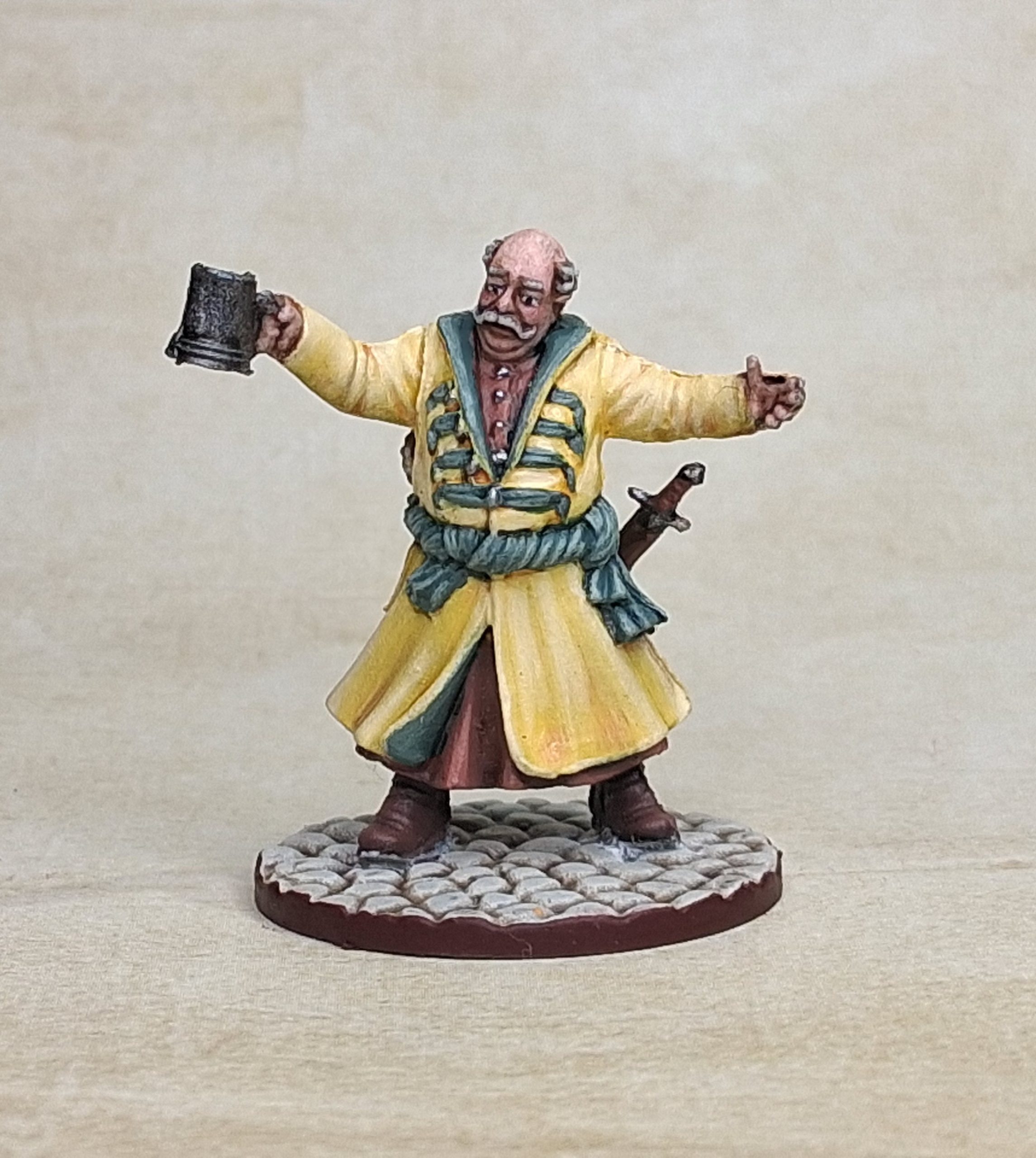
Defenders of the Crown - Zagłoba
Born in the year 1600, during his long years of service, Zagłoba (Zag-wo-ba) has fought against the armies of Gustav II Adolf in Livonia, and subsequently against the Chmielnicki (kim-el-nyet-ski) uprising. Supposedly he was part of hetman Żółkiewki’s (Zuw-kiev-ski) army at the battle of Cecora, where he was captured and imprisoned by the Turks for several years. Fond of drinking, celabration and wild stories if his exploits and with a penchant for overexaggeration, it is often hard to tell which of his stories are true. However, his buffonish visage belies a keen mind and he is valued for his ideas, his intelligence and his sharpe tongue. During the seige of of Zamość (Zamosh-ch), a battle of The Deluge (a Swedish invasion of Poland-Lithuania), King Gustav Adolfus of Sweden offered the city’s commander, Jan Zamoyski, heredetary voivoidship of Lublin, a Polish-Lithuanian Commonwealth territory , if he opened the city’s gates and surrendered. Zagłoba then asked Zamoyski to offer, by way of reply, the province of the Netherlands in exchange. The message was relayed to Adolfus in Latin and everyone who heard the exchange laughed at the Swedish King. Zamoyski refused to open the gates and seeing that the city was well defended the Swedes withdrew. At 66 years of age, his mind and his wits are as keen as ever and he still serves the commonwealth loyally.
Zagłoba is an entirely fictional character of Henryk Sienkiewicz’s (shen-kyay-vitch) making and is one his most enduring characters, even being featured in a Polish beer advert in the year 2000. He is often likened to the character of Falstaff from Shakespeare’s Henriad plays. The penchant for drunken revelry, the over inflation of his own achievements and general mischieviousness make them both great comical relief and both characters are well loved by audiences. However, unlike Falstaff, who begins and ends his story as a drunkard and a charlatan, Zagłoba undergoes significant character development. His actions are often selfless rather than selfish and not just because it is convenient or in his own interests to be selfless in a given moment, unlike Falstaff who is typically on the lookout to gain whatever advantage (or coin) that he can for himself.
The model is a suitably characterful model for such a well loved character. where the other models are posed ready for battle, Zagłoba is posed holding a large mug, presumably of beer, with his arms outstretched, almost in greeting, as if he is perhaps trying to de-escalate a situation. Or perhaps to trick an enemy into letting their guard down around harmless old man, before he smashes them around the head with the tankard. The artwork portrays him wearing a yellow coat of some kind with a green sash around the waist. However there is no visibility of what is under tha jacket because it is completely buttoned up, so I had to take some liberties. I am incredibly pleased with how the yellow has turned out as it is a notoriously difficult colour to paint. This really was achieved using “two thin coats”, as the saying goes, using army painter fanatics Warped yellow. Getting the opportunity to paint Zagłoba was a bit like painting Porthos’ red outfit. It’s a really nice break from the more muted colours of the Dragoons (and a couple of the characters share that same palette). To tie him into the rest of the faction, I painted whatever it is that he is wearing under his coat in a reddish brown colour. The face was also a real joy to paint, very characterful and with so much pronounced details, even on this PVC model; The double chin, the large, curved moustache and the drooping eyelids were all really well sculpted and just made this really fun to paint. I even painted his eyebrows! Overall, really pleased with this model and it’s fascinating to learn about these characters from a culture that I know virtually nothing about but I am now eager to learn more.
Defenders of the Crown - Dragoons
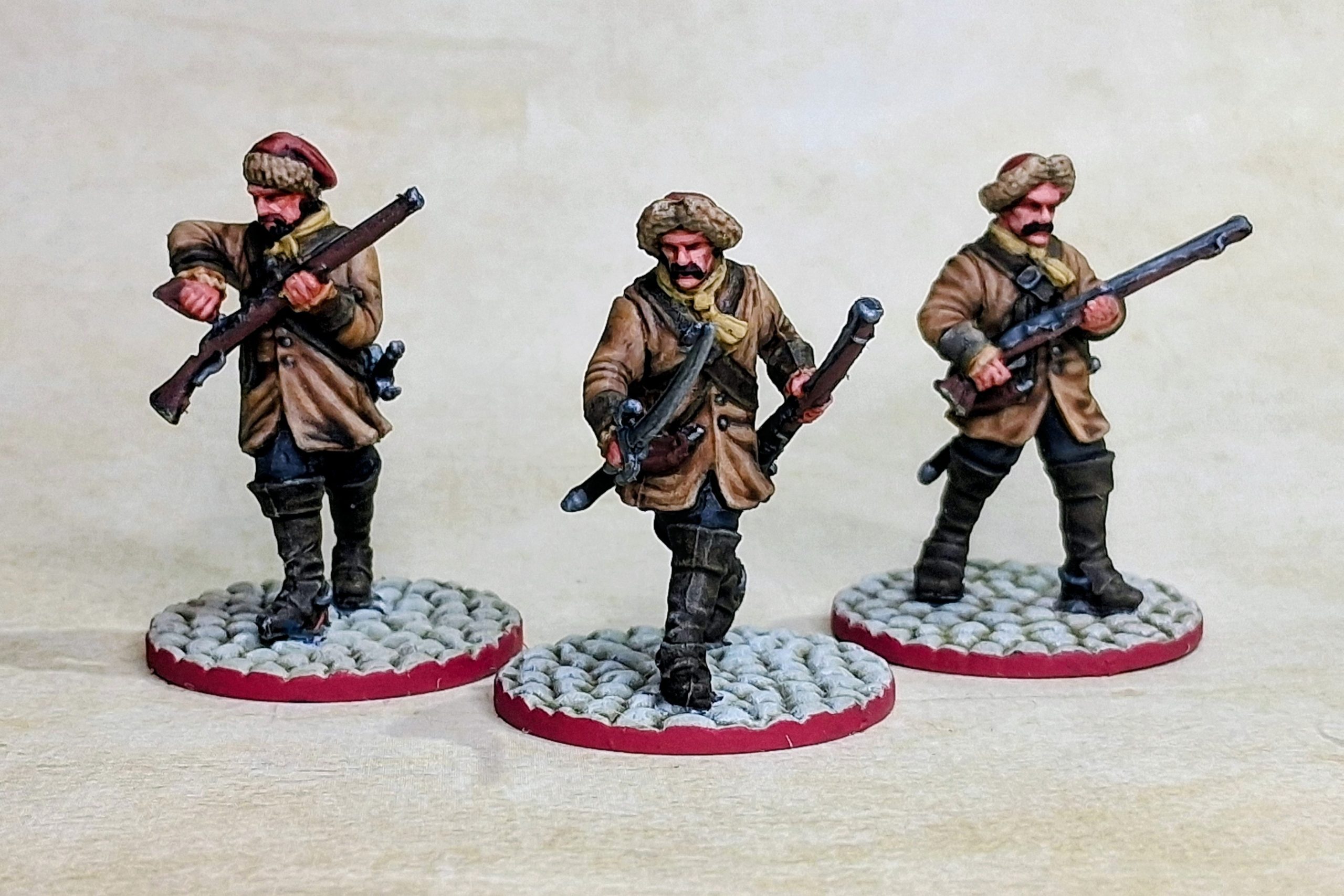
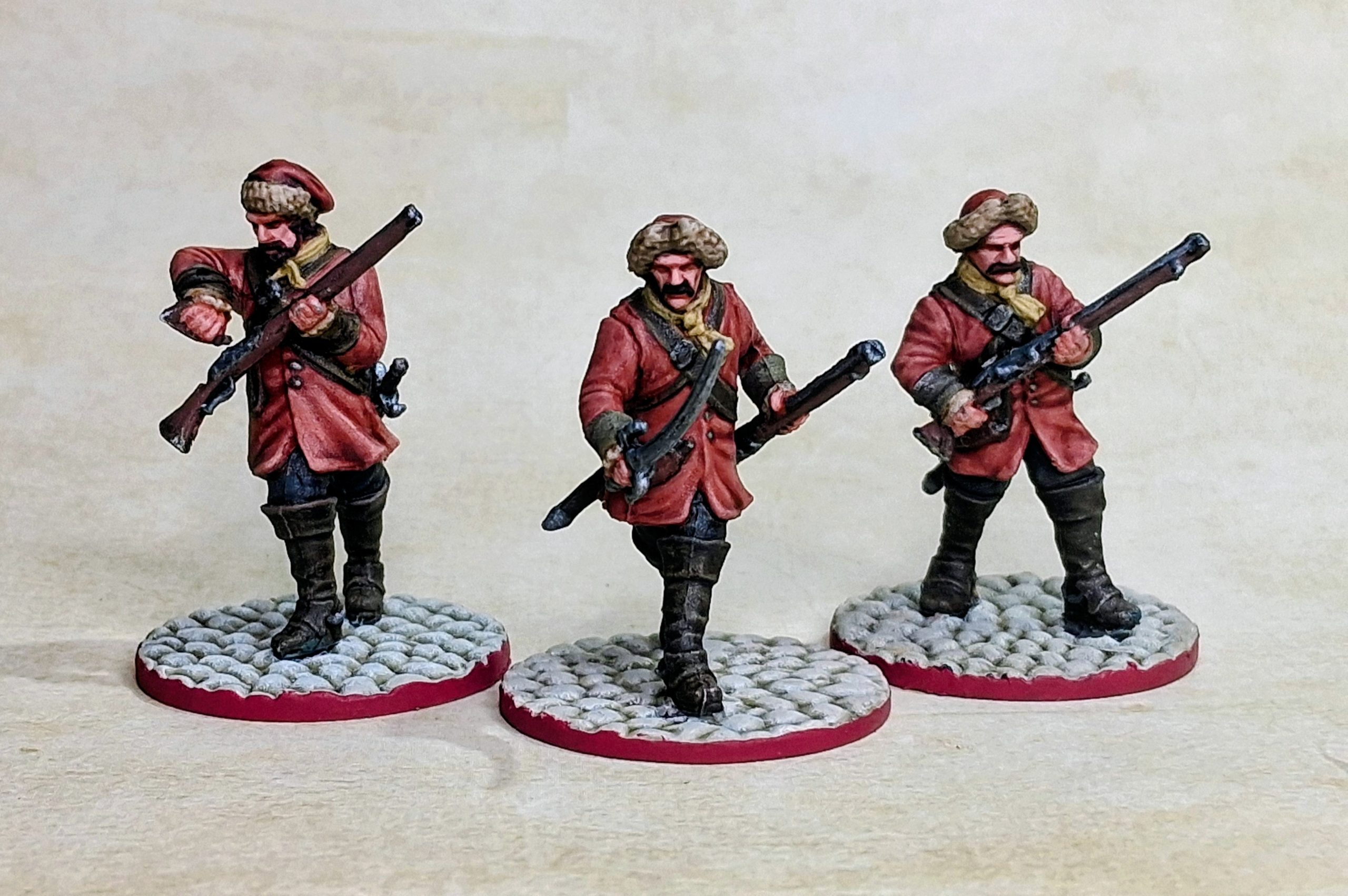
The other faction that comes in the main Anno Domini 1666 box are the Polish-Lithuanian Defenders of the Crown. Much like the Royal Musketeers, they too are based on a fictional work, this time being drawn from the works of Henryk Sienkiewicz. Anyone who knows anything about Wargamer Studio will know that as a Polish company they draw heavily on his works, their main product range being the 15mm game By Fire and Sword, the name of which is lifted from the first novel in his Trilogy series. Within the Anno Domini 1666, we will meet many characters from these stories, all of whom have names I had to contact the game’s authors for advice on how to pronounce. But to start us off I have the basic troops – the Dragoons. These guys are to the Defenders of the Crown what the Musketeers are to the Royal Musketeers. As with the muskteers faction, I also purchased an extra box of dragoons so I could have a detatchment of Elite Dragoons that looked visibly different to their regular counterparts. Unlike the musketeers, I didn’t have to wait over two years before painting the Elite troops, I did them all in one go.
The colour schemes for both are the same, with the exception of the jackets. Nominally, the “colour” for this faction is red, much like the Musketeers could be said to be blue. The faction icon is red and red is the most commonly occuring colour. The basic troops don’t really seem to display a lot of the faction colour, they wear a simple, brown jacket and dark grey pants. The only red visible is the hat. So for the Elite dragoons, I made the jackets match the hats. I also muted the red down a little, creating a more red/brown colour scheme as I wanted the soldiers to have a slightly faded look and it also allows the elite soldiers to better complement the basic troops. These soldiers all look like seasoned, battle hardened soldiers and so also provide a nice contract to the more brightly coloured Royal Musketeers, who have a much cleaner look owing to them being the personal troops of the King of France
Royal Musketeers
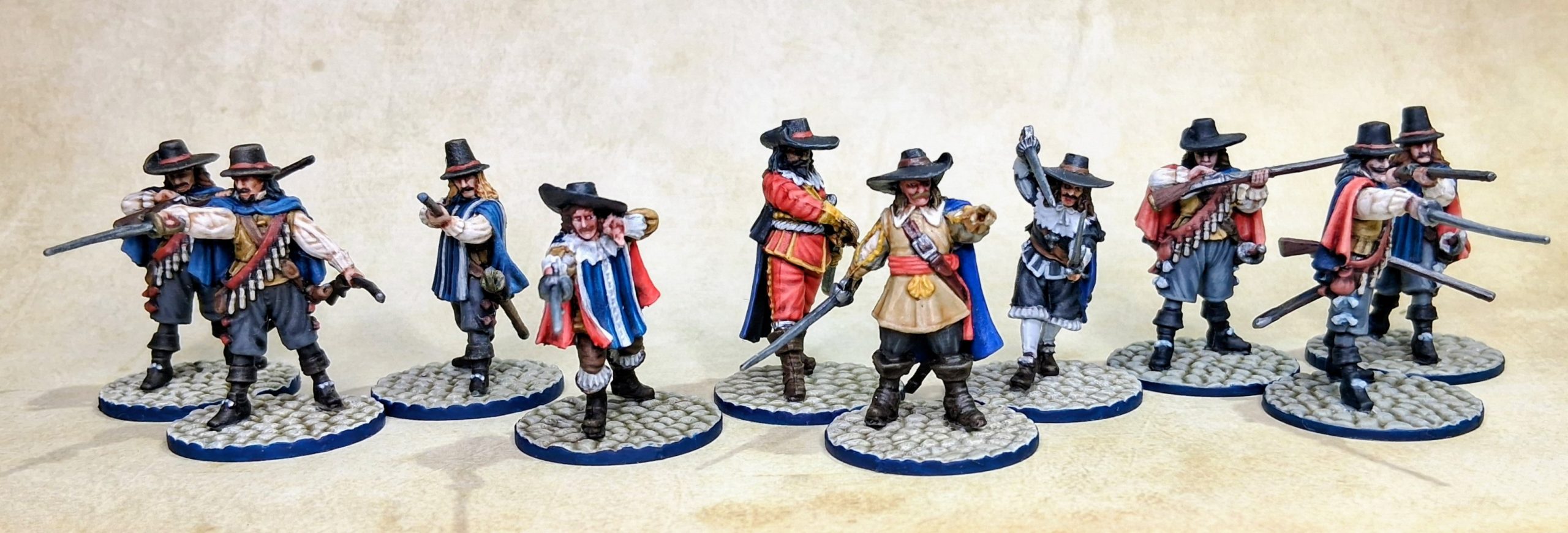
That’s my first faction complete. I will soon be moving on to the other “in the box Faction” (i.e., comes in the base game), the Defenders of the Crown, hailing from the Polish-Lithuanian Commonwealth. However I thought it would be nice to just see the whole faction together. The main characters are in the middle, flanked by two detachments of Musketeers.
Royal Musketeers - Elite Musketeers
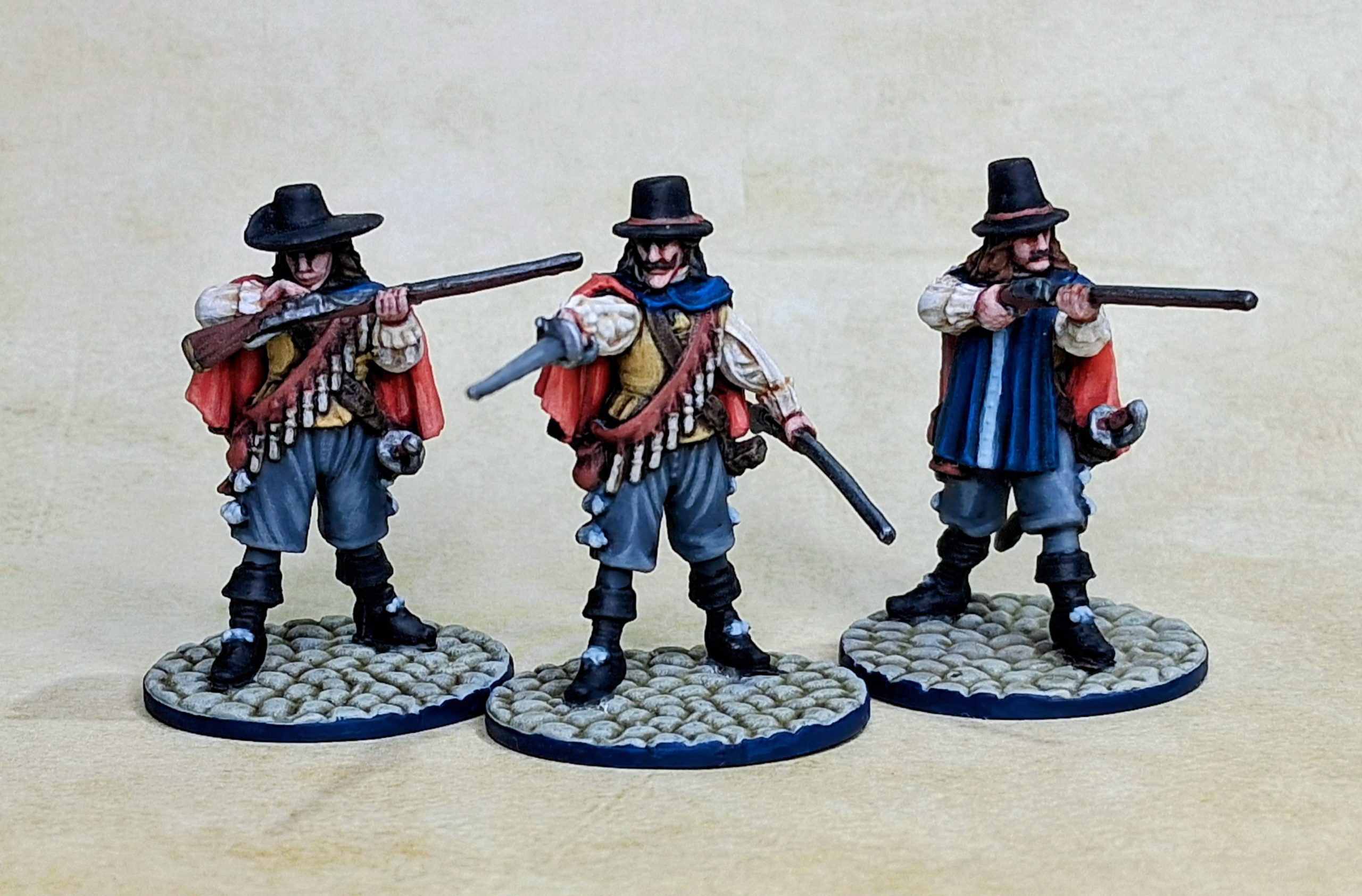
I found out, after purchasing the game, that there are troops, and then there are Elite troops. The artwork for both is exactly the same, but me being me, I wanted something different to denote the elite troops. So I purchased an extra box of Muskteers, which does mean I have ended up with a lot of extra, duplicate cards, but it also means I can paint three models in a different colour scheme. For this, I went with a more historically accurate colour scheme, which matches the colours worn by D’Artagnan. The major change to the uniform was the darker blue and the red lining. On a side note – why is Dark Blue so hard to come by? I remember a colour that GW used to make, I think it was called Necron Abyss or something, and it was really, really dark. GW seem to have given up on that and the darkest colour I could get my hands on was Dark Prussian Blue, which I had to then apply two coats of blue wash (Drakenhof Nightshade) to get it to a suitably dark tone.
Royal Musketeers - D'Artagnan
D’Artagnan, a young noble who left his home in Gascony for Paris, full of ambition to become a Muskteer. On arrival in Paris, he met, and quarreled with, each of the “Three Musketeers”, Athos, Aramis and Porthos, ultimately leading to him challenge each of them to a duel. However he quickly earned their trust and friendship and became involved with all of their adventures. Loyal to the King and the Musketeers, he eventually became a captain of the regiment. Tragically, he met his end during a seige during the Franco-Dutch “War of Devolution”, moments after finding out he was to be made Marshall of France. His final words were “Athos, Porthos, au revoir! Aramis, adieu forever!” – Aramis being the only one of the 4 comrades to survive.
As a character, D’Artagnan is the primary protagonist of the Dumas novels (The collective name for the stories is “The D’Artagnan Romances”). He is based very loosely so on the historical Charles de Batz de Castelmore d’Artagnan, or the “Comte D’Artagnan”. I can see why Dumas shortened it to “D’Artagnan”. Much like his namesake, the real Comte D’Artagnan was also involved in espionage, serving Cardinal Mazarin (Richelieu’s successor). In the final novel of the series, Ten Years Later (from which the film The Man in the Iron Mask is drawn), D’Artagnan arrests the finance minister, Nicolas Fouqet, for financial corruption dramatising actual historical events. Also like his fictional counterpart, the Comte D’Artagnan was killed during the seige of Maastricht in 1673. However as he was shot through the throat, it is unlikely he had the time to say a final farewell to his friends.
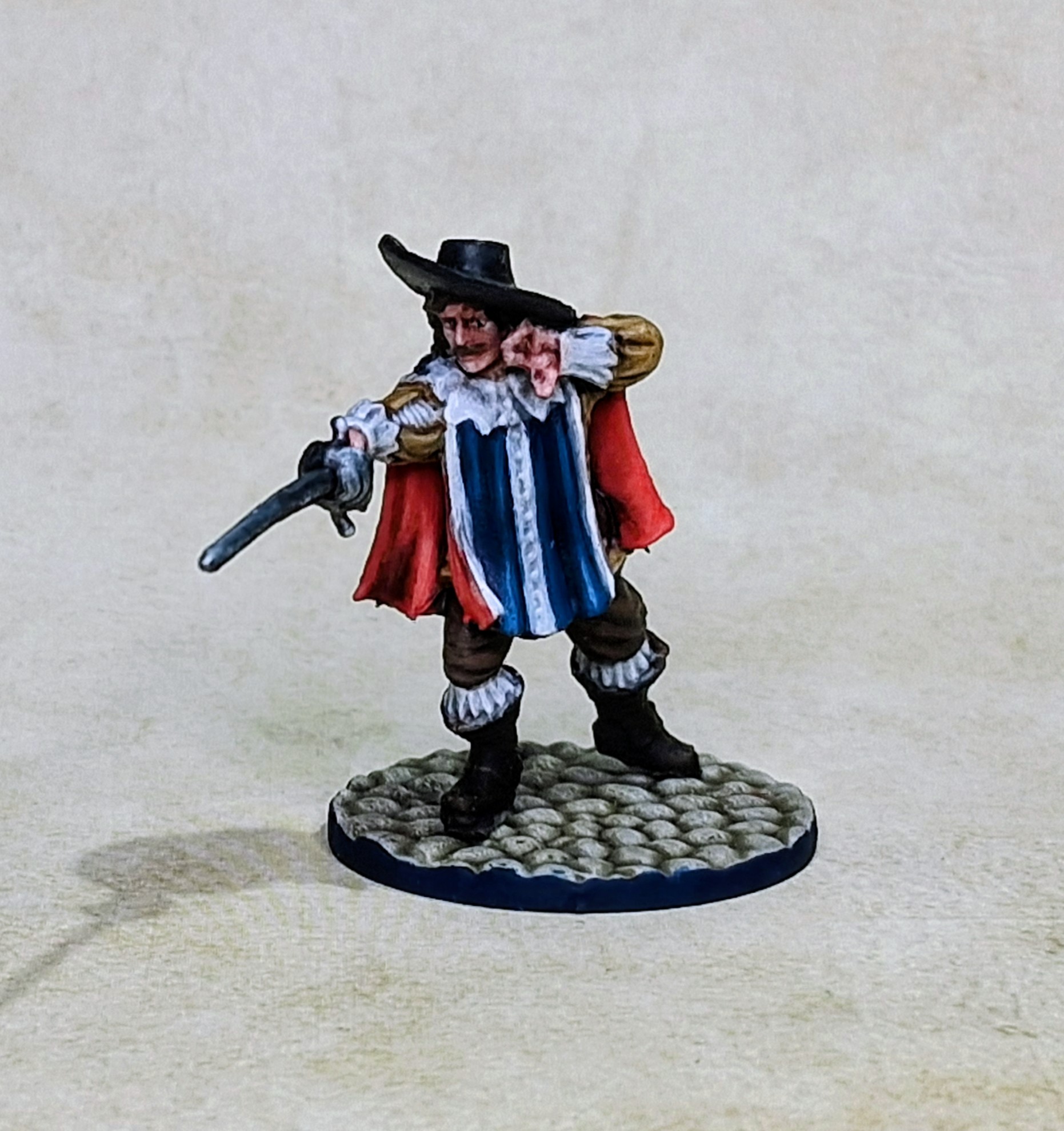
As a model I found the pose on this a little strange – I am unsure what he is doing with his off hand. However, pose aside, it’s interesting that of the 4 main characters, only D’Artagnan is wearing a musketeer uniform. I am not familiar with the customs of the time, so I cannot be sure whether Athos’ outfit would be considered a uniform, certainly military attire but quite generic – a simple buff coat under a cape. However, neither Porthos nor Aramis are wearing military dress, D’Artagnan on the other hand has the same uniform as the rank and file muskteers. To paint this, and to set him apart from the troops, I used a historical reference for Muskteer uniforms. The original troops are based on the game art, which in turn is similar to the uniforms seen in 1993 film. However actual uniforms were a much darker blue with a red lining and if you google it, you will also note that the regiment was active all the way through to 1816, although during the turbulent, revolutionary years they were disbanded and reformed a number of times.
Royal Musketeers - Porthos
Portho was renowned for his love with life and his generally carefree personality and outlook. He loved to indulge in celebration, eating and drinking and did so with as much fervour as he engaged in battle – his eating abilities even impressed King Louis XIV. He was known for his physicality, his size and strength but throughout his adventures with the other musketeers, his stature and character grew to match his physical presence. Despite outwardly appearances, he is fiercely loyal to his fellow musketeers and takes that friendship very seriously. He supported his friend Aramis’ plot to supplant Louis with his twin brother Phillipe (the man in the iron mask), a plot which ultimately failed, forcing both he and Porthos flee to a place known as Belle Île. The island had been fortified by one of Aramis’ allies – the Superintendent of Finances, Nicolas Fouquet, a man who would later be arrested by D’Artagnan. After Fouquet’s arrest, D’Artagnan was ordered to then arrest Aramis and Porthos but out of love for his former comrades, he deliberately delayed, granting them both time to escape. The deception was uncovered by one of D’Artagnan’s rivals who took matters into his own hands and tried to arrest the two fugitives himself. As Aramis and Porthos attemptes to flee la Bell Île, Porthos was shot and killed, leaving Aramis to escape to sea alone. Porthos’ death affected Aramis deeply and he was said to have felt remorse for the first time in his life.
Porthos is based on the historical character, Isaac de Porthau. There isn’t tonnes of information about him online, although I am sure if I had more time I could find more. However, he was a notable member of the Muskteers, specifically the “Black Musketeers”, which, combined with Dumas’ own heritage, has given rise to the idea that Porthau was black or mixed race. It is unlikely that this is the case and the confusion arises from the fact that Alexander Dumas’ own father was a high ranking black French officer known as “the Black Musketeer” or “the Black Devil”. The “Black Musketeers” were a company within the Mousquetaires du Roi noted for their black (as opposed to blue) uniforms. You will see these uniforms on the musketeers in the final act of the film, The Man In The Iron Mask. He was the First Cousin Once Removed of Captain Troisville (meaning Porthau’s father was Troisville’s cousin, if anyone is wondering) and served a few years in a different regiment before earning a spot in the musketeers. Unlike his fictonional counterpart, Isaac de Porthau lived to a ripe old age, dying in 1712, aged 95
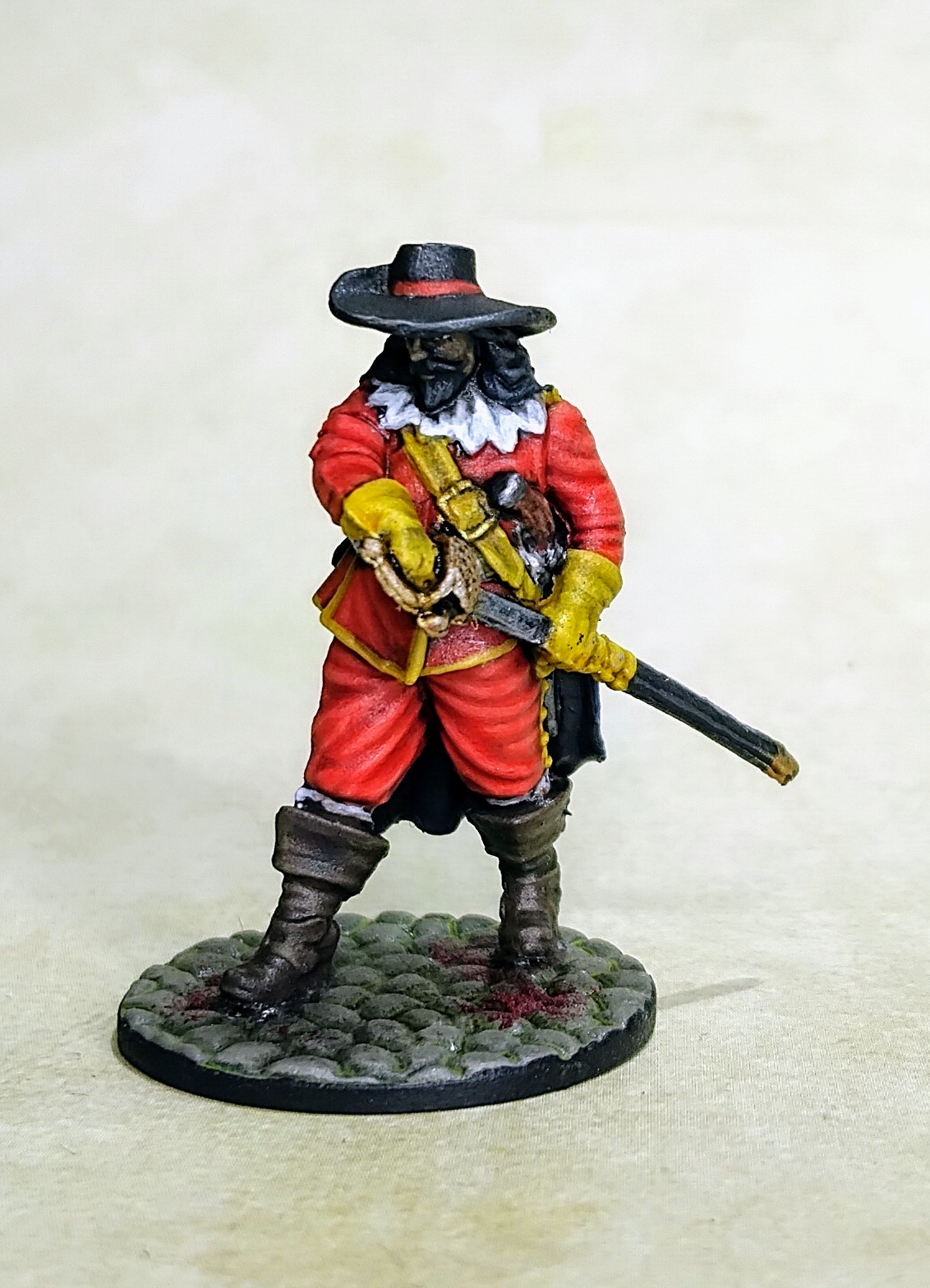
I have to say I have no idea where the inspiration for these comes from. When I look at the other factions in the game, you can often see resemblance to images from films, so I find it strange that the musketeers, whose story has been told on film many times, don’t seem to be have been drawn from one. Anyway, curiosity aside, I opted to deviate slightly from the artwork with the skin. As mentioned, there are lots of theories that Porthos may have been mixed race – Alexander Dumas himself was also of mixed parentage – and while I doubt very much that they were true, I leaned into a bit here. Partly because I like Howard Charles’ portrayal of him in the BBC series and also because I just fancied trying out the new Army Painter Fanatics dark skin tone paints. Overall, I think it’s turnout really nicely considering the general quality of the PVC models that come with this game (Seriously – anyone looking at this as something they might be interested in, buy the metal stuff). The red uniform that Porthos is wearing here is probably inspired by later, 18th century musketeer uniforms, which featured a red jacket and trousers under a blue vest or sleeveless jacket. During the time period of the game and the novels, the uniform was a basic shirt and pants underneath a sleeveless, blue soubrevest lined with red. Still, the red is quite striking and provides a nice contrast to the darker tones of the rest of the models
Royal Musketeers - Athos
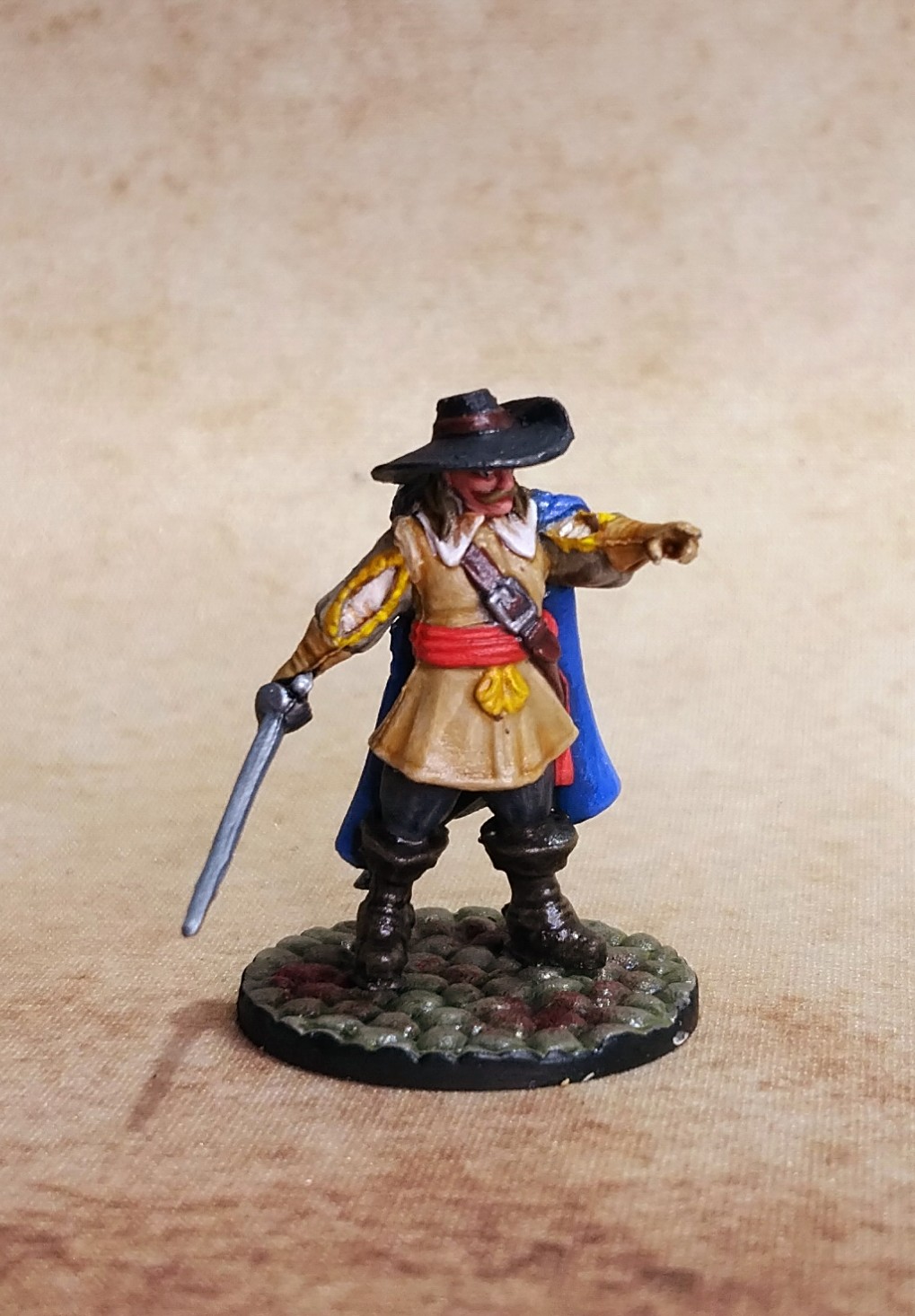
Athos, was very much the “senior” musketeer and often thought of as the leader of the group (although in the game, which is set somewhere towards the end of the timeframe of the final novel, D’Artagnan is the faction leader as befits his status at that time). He was stern and taciturn, often melancholy and prone to drowning his sorrows in drink for Athos also carried with him a secret history. Once, he was, married to Milady de Winter, who by the start of the D’Artagnan Romances, was a villainous agent of Cardinal Richeliue. Athos discovered after they were wed, that she was in fact a criminal on the run, wanted for murder. After discovering this truth he tried to kill her and ultimately abandoned his former life of privilege as the Comte De La Fére, to become a musketeer, adopting the nom-de-guerre of Athos, which is the only name that his peers knew. This left a deep scar on him, leaving him jaded and bitter, but despite that he was still loyal to his friends and protective of the young D’Artagnan. Ultimately he got his revenge on Milady, seeing her captured and executed for her crimes, but that did not truly make him happy. In later years, he has a son, out of wedlock, named Raoul whom he formally adopted (thus making Raoul heir to the position and title of Comte de la Fére). It is in his son that he truly found happiness. He was also involved in the English Civil War, attempting to rescue Charles I and eventually assisting Charles II in his restoration to the throne. However his end was ultimately tragic as his son Raoul was killed in battle in Africa, after being sent to a dangerous part of the front by King Louis XIV who had fallen in love with his fiancée. Upon hearing this news, Athos withdrew to his home but was overcome with grief and died.
I think this quite nicely captured in the model. The uniform is simple and plain but ultimately functional, a soldier’s uniform of a simple buff coat over a shirt and britches with a red sash around his waist, something that is very common among officers which, along with the pose, helps to create an air of command about him. I have to say that the camera has let me down a bit in the photograph as the contrasts painted on the coat aren’t really as pronounced as the appear on the actual model. As with the other models in the group, he wears a royal blue cloak to identify him as belonging to the musketeers. Also the details on the face weren’t particularly crisp and that made the eyes especially difficult to paint.
Royal Musketeers - Aramis
Aramis, the priest. Aramis the lover. Aramis the Soldier. In the Alexander Dumas novels, Aramis is portrayed as a conflicted individual, never really satisfied with life. He flits from priest to soldier to priest. He courts pretty noble ladies, often his undoing but also in keeping with the opinions and attitudes of Jesuits of the time. Like the other two musketeers, he is is incredibly loyal to his friends above all else and the only time he is really seen to show remorse is over the death of Porthos (spoiler alert!). As another snippet of trivia (and another spoiler), Aramis is the only one of the 4 friends to survive. By the end of the D’Artagnan Romances, Aramis has escaped to Spain, where he assumes the title of Duc d’Almeda and is appointed the ambassador to France.
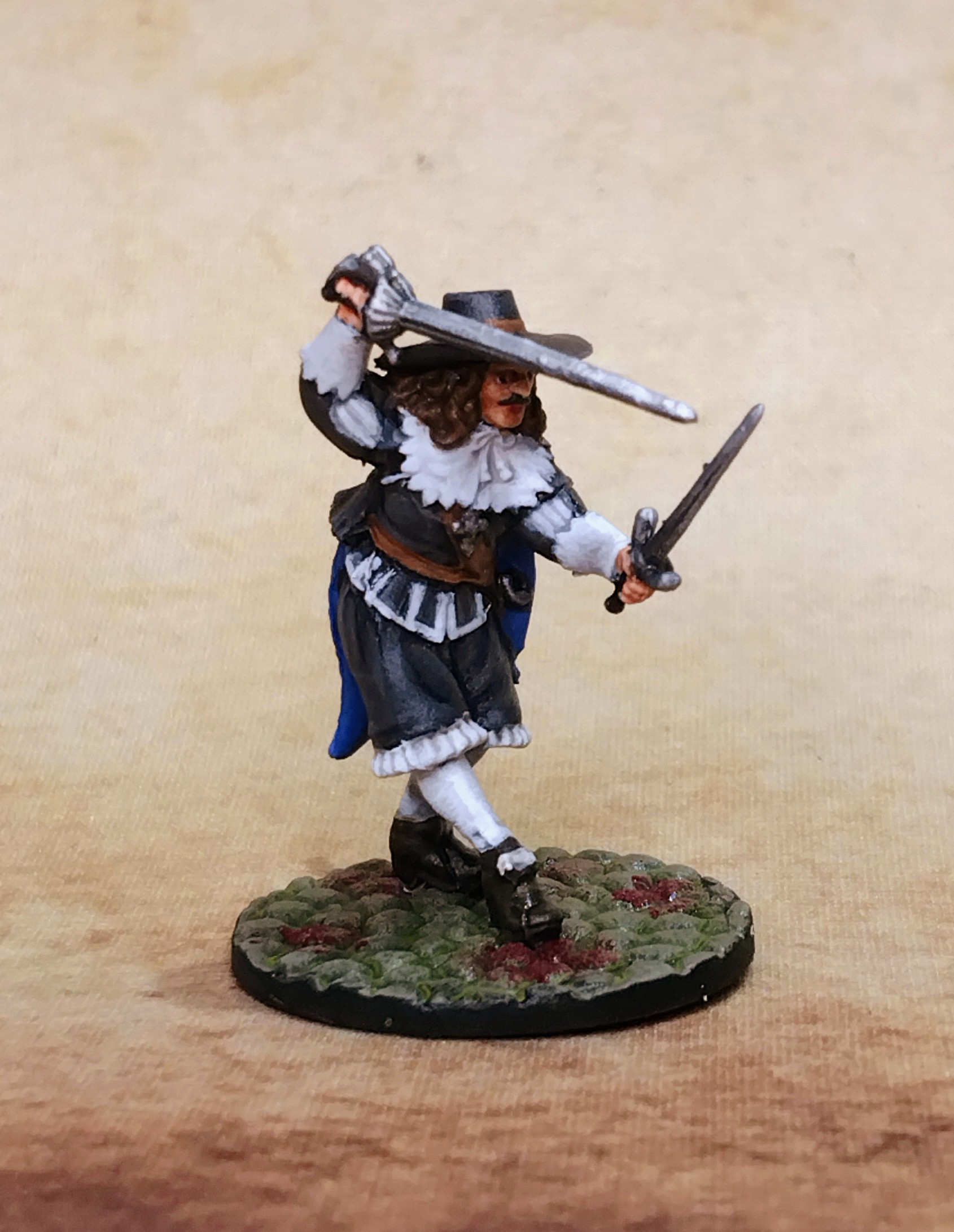
The artwork from the game, on which this is based, shows aramis in a black and white outfit, which is somewhat reminiscent of the black uniforms of may jesuit priests. However it also has a flamboyance to it which matches his reputation as something of a lothario – a skill he also carries into the game.
To paint this, I used Necromancer Cloak from Army Painter (which has now been discontinued) mixed with a tiny bit of black paint to get a really nice dark grey and over that I just used Nuln Oil. This creates quite a muted look but I think it makes the material look quite heavy and rich, more like a wool than a silk.