


































![Very Cool! Make Your Own Star Wars: Legion Imperial Agent & Officer | Review [7 Days Early Access]](https://images.beastsofwar.com/2025/12/Star-Wars-Imperial-Agent-_-Officer-coverimage-V3-225-127.jpg)




The Desert War: Gaming WW2 in North Africa Part Three – Pushing the Envelope
August 31, 2015 by crew


Once more we venture into the deserts of North Africa, discussing and recreating some of the decisive battles that took place here during World War II. For those just joining us, we took an overview of the Desert War’s origins in Part One, and then reviewed some of both sides’ early successes in Part Two. Now both sides are pushing the envelope, bringing in still more forces and driving them as far and as fast as they possibly can.
Care to join us? Do you have what it takes to engage and defeat an elusive and ferocious enemy, assuming the desert doesn’t kill you first?
As we saw in Part Two, Rommel wasted no time in making an impact when he arrived in Africa. With only a handful of units from his 5th Light Division (the first battalions to get off the boat), he launched a blitz in March and April of 1941 that regained all territory the Allies had just taken in Libya. British forces took a terrible beating and their commander, General Richard O’Connor (the hero of Operation Compass), was captured along with much of his staff.
With O’Connor doing his best to enjoy German hospitality, his boss General Archibald Wavell had to take charge personally. Wavell’s forces in Egypt were still terribly weak, however, thanks in part to Allied commitments against the Germans in Greece and the Italians in East Africa (Abyssinia, Eritrea, and Somalia). Nevertheless, just a month after taking command, Wavell went on the offensive against Axis positions in Libya with Operation “Brevity.”
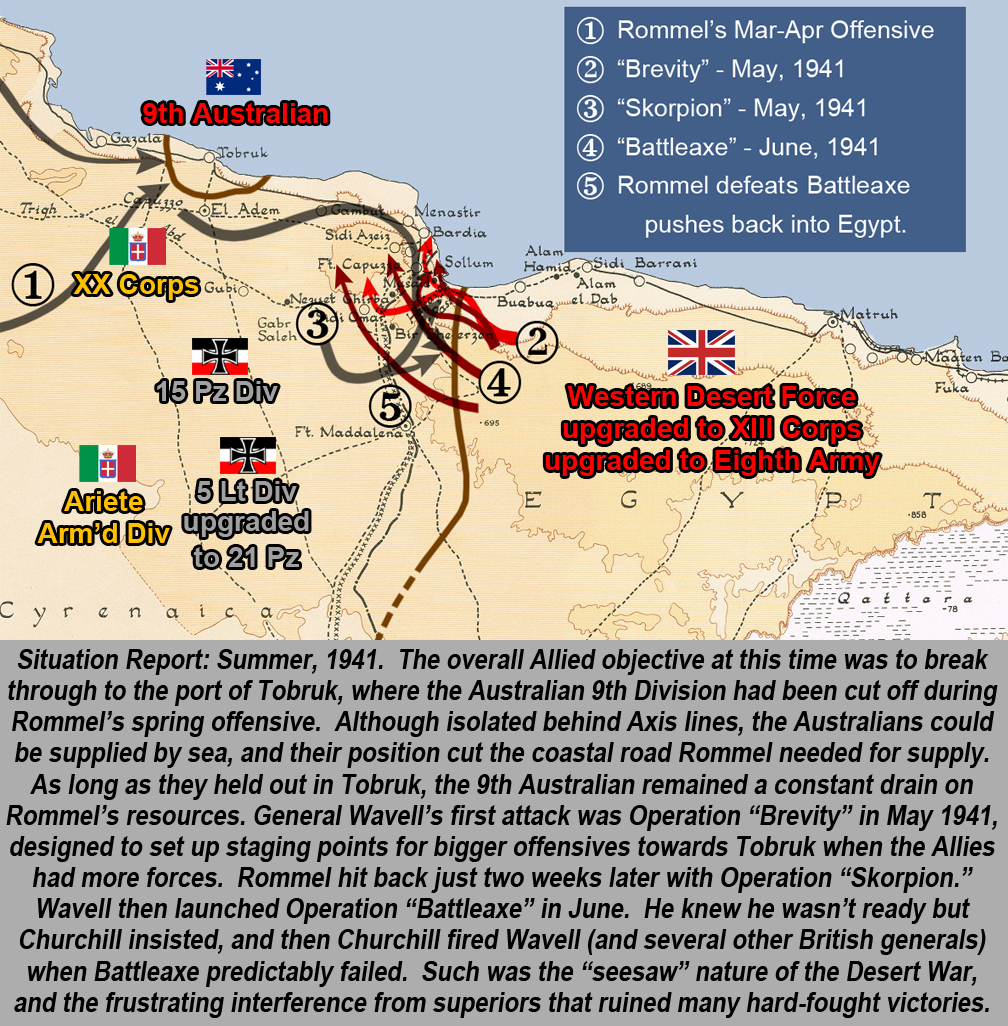
As we can see in the above map, the Desert War swung wildly back and forth through the summer months of 1941. Brevity, Skorpion, Battleaxe, none of these attacks achieved significant gains. Meanwhile the 9th Australian Division (and other units) held out in Tobruk, withstanding repeated Axis attacks for month after month, all while standing astride the only easy road Rommel could use to draw supplies from depots in Benghazi and Tripoli.
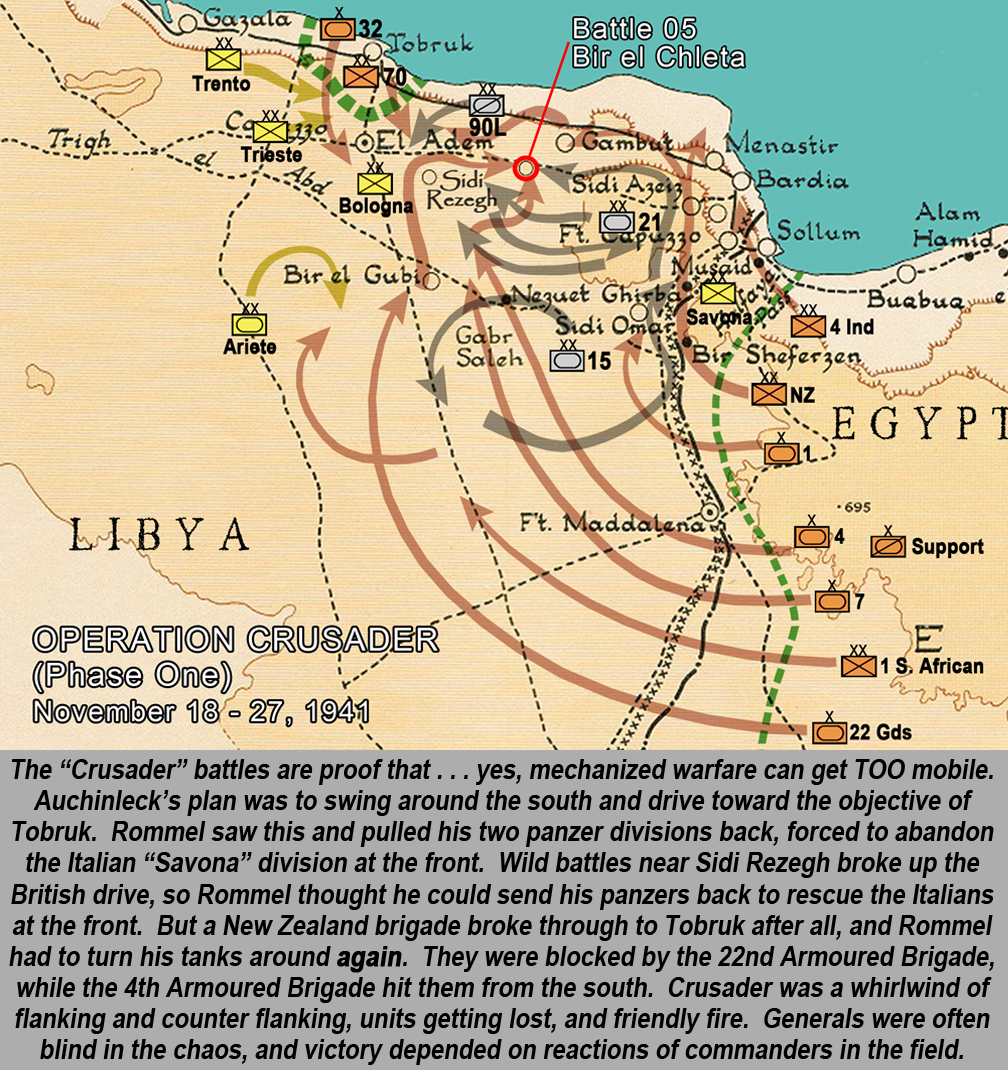
Finally, Wavell’s replacement, General Claude Auchinleck, came up with a plan to break through to Tobruk once and for all. He called his attack Operation “Crusader.”
OPERATION CRUSADER
For our fifth game, we tried to recreate part of the wild, confused, free-wheeling combat that so typified Operation Crusader. We selected an engagement on November 27th, where exhausted remnants of the 15th Panzer Division once AGAIN raced toward Sidi Rezegh to prevent a New Zealand breakthrough to Tobruk. Here the Germans were caught between elements of the 22nd Armoured Brigade in the west and 4th Armoured Brigade from the south.
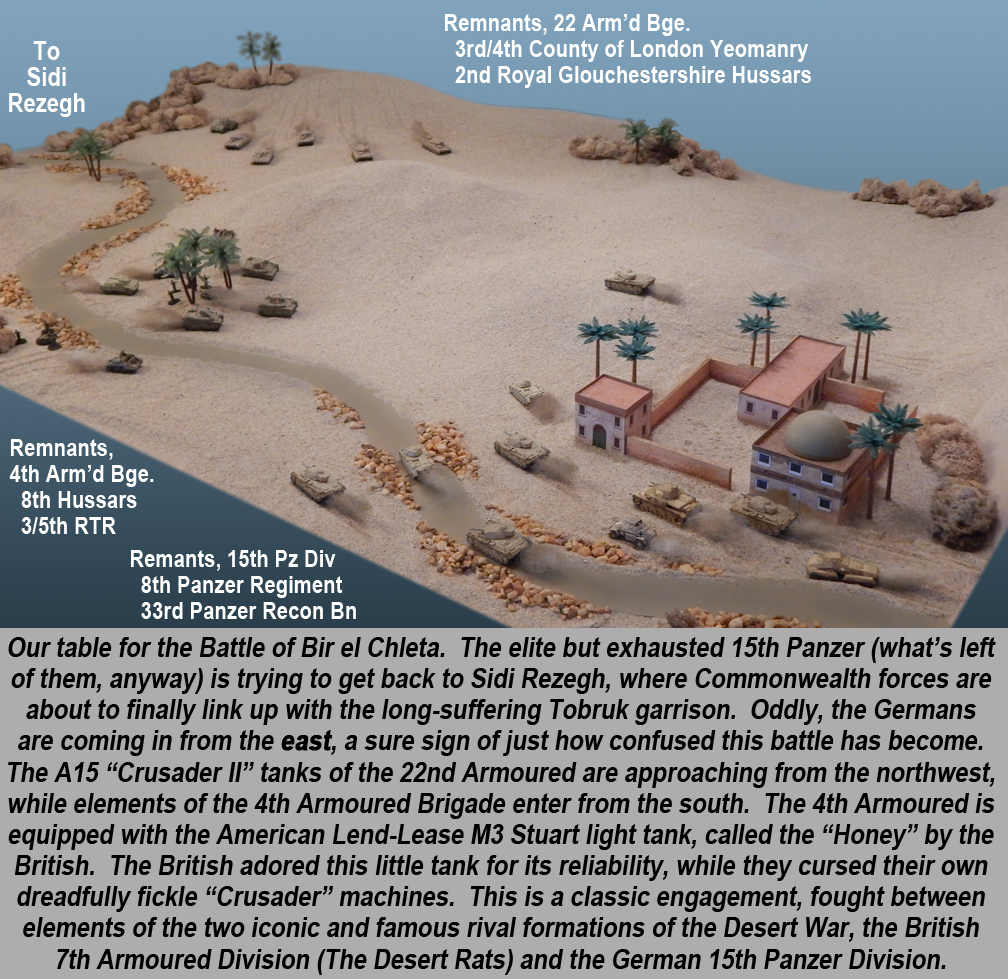
If it looks like our tables are getting more crowded with tanks, it’s not your imagination. The Crusader battles were fought with much larger forces than previous Desert War because both sides had feverishly built up forces through the summer and fall of 1941. For starters, the British “Western Desert Force” (already upgraded to the XIII Corps) was finally upgraded to the Eighth Army everyone remembers in the desert.
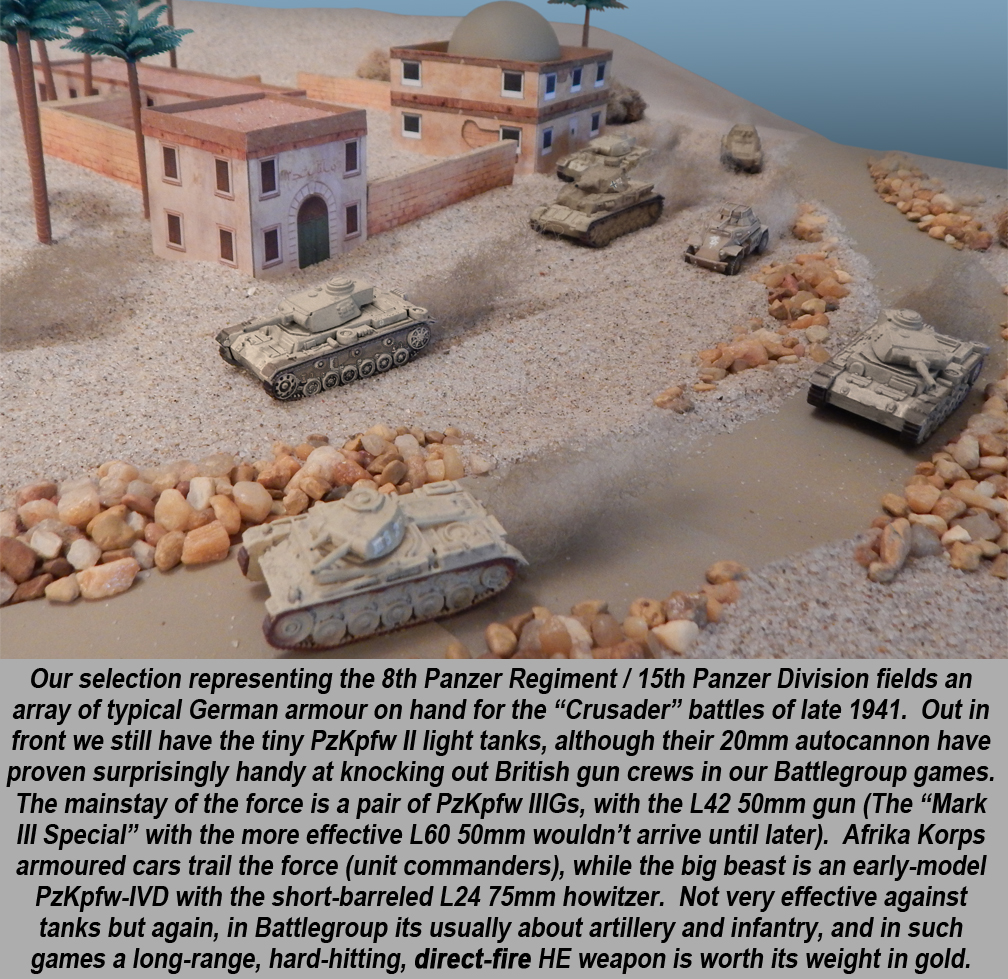
Rommel, meanwhile no longer commanded the Afrika Korps. His 5th Light Division had been upgraded to the 21st Panzer, and a new 90th Light Division had arrived. Also, most Italian forces in North Africa were formally placed under Rommel’s command. Thus, the “Afrika Korps” was now only part of Rommel’s newly-minted “Panzergruppe Afrika.” So, technically speaking, Rommel only commanded the Afrika Korps for about five months.
The Afrika Korps (currently the 15th Panzer, 21st Panzer, and 90th Light Divisions, plus attached support units) was actually now commanded by the very capable General Ludwig Crüwell. Rommel and Crüwell were known to disagree violently at times, but together they made a formidable team when faced with a crisis.

Operation “Crusader” was an undeniable success, relieving Tobruk and ending its 241-day siege (the 9th Australian had been evacuated by sea and replaced some time ago with the 70th Infantry and 32nd Tank Brigade, along with the Polish 1st Carpathian Brigade and the 11th Czechoslovak Infantry Battalion). By the time the Allies were finished on December 30th, Rommel had been tossed all the way back where he started at El Agheila just eight months before.
Churchill pressed Auchinleck to push further, but Commonwealth supply lines (stretching 650 miles back to Alexandria) yanked them to a halt like dogs at the end of iron chains.
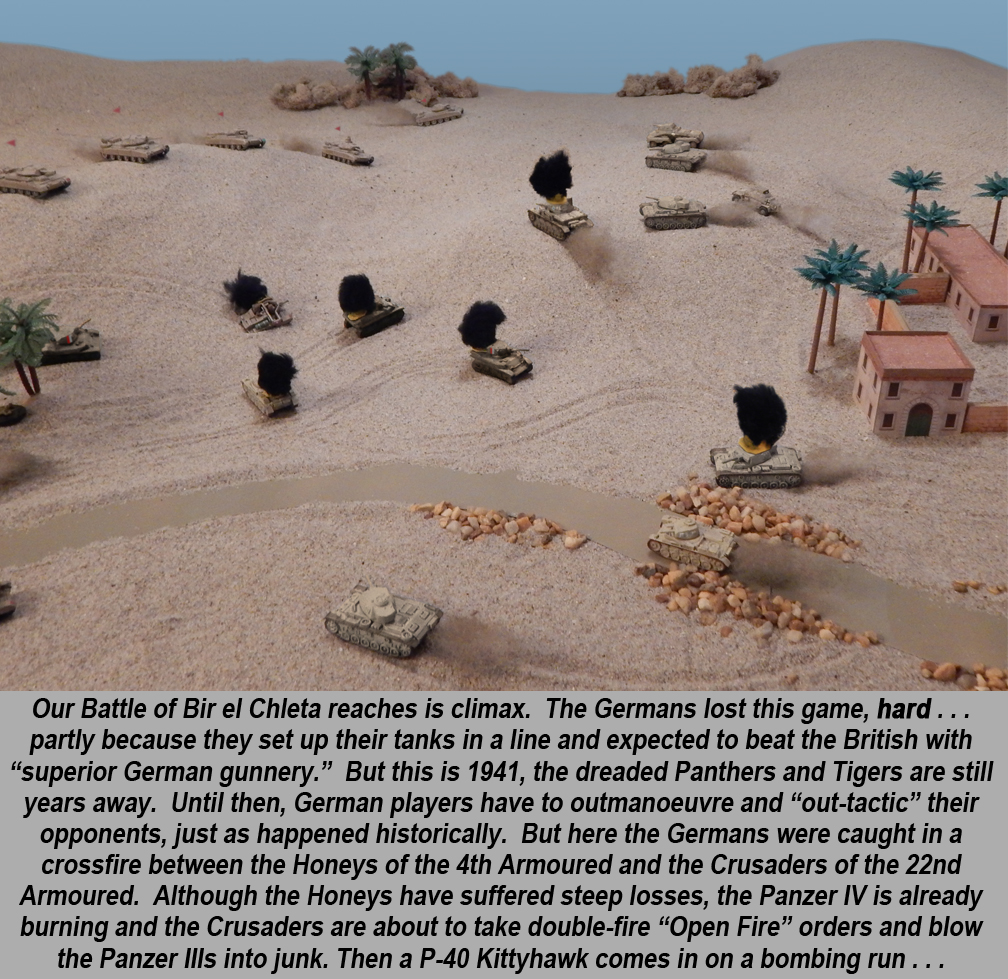
Rommel, meanwhile, was now much closer to his supply base at Tripoli, a factor which helped his counterattack just two months later (January, 1942). Yet AGAIN the British were pushed back across Cyrenaica, although this time they managed to halt the Germans and Italians short of Tobruk.
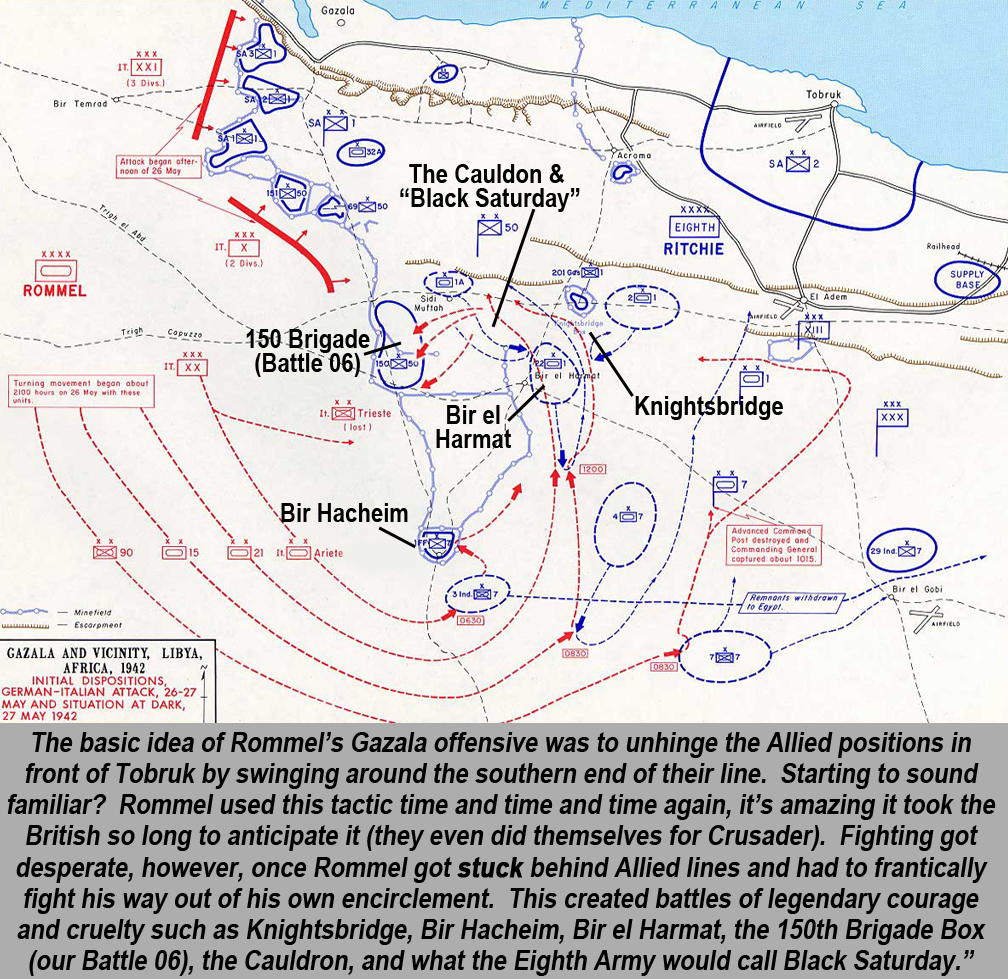
The line settled near a town called Gazala, where Rommel would soon achieve his greatest, and perhaps most flawed, battlefield masterpiece.
GAZALA – THE RAZOR’S EDGE
Rommel’s offensive started well. After smashing through the 7th Armoured Division, his “right hook” got behind the British easily enough. But Rommel had pushed too far behind the Allies. Soon it was difficult to tell who was “cutting off” who, the armies were like two wrestlers who had each other in a headlock.
The matter was now of brute force and determination, with survival going to whoever choked out his opponent first. This “gut check” was the battle selected for Game 06, with the Germans and Italians trying to chew their way through the British 150th Brigade...chew their way out of a trap of their own making.
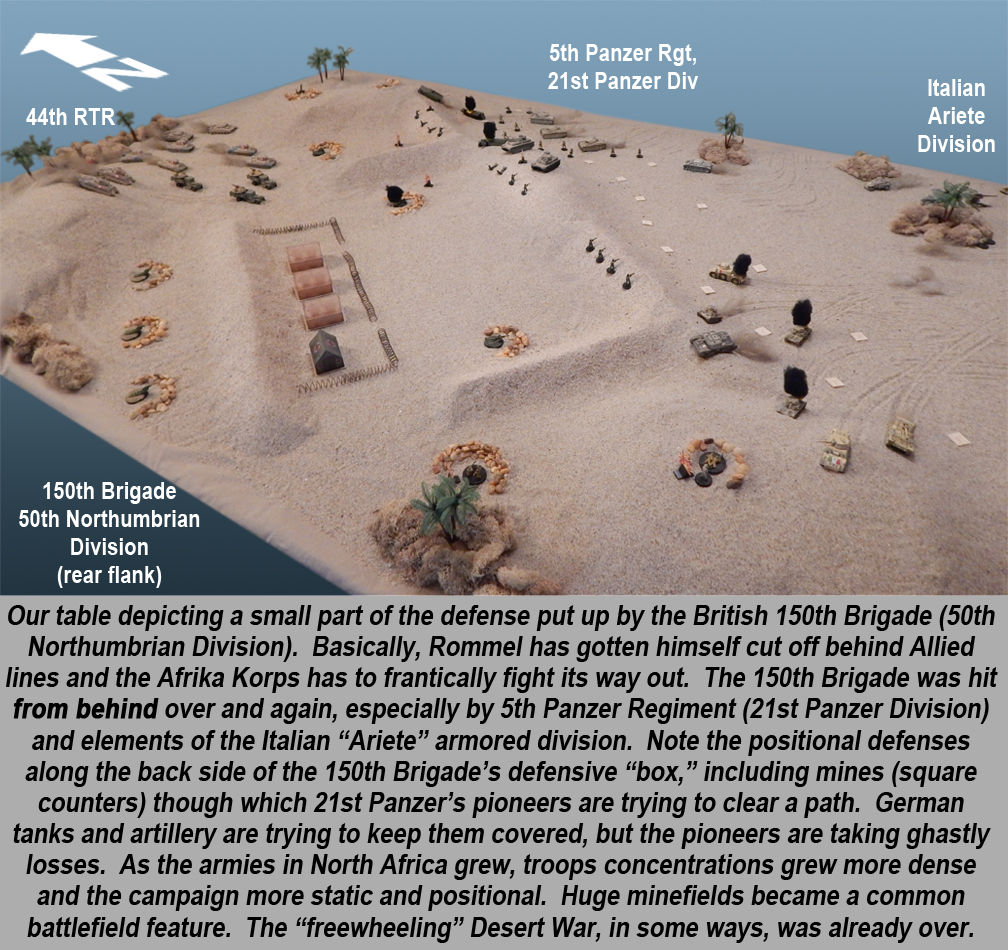
Eventually Rommel did break through, re-opening a route back to his own lines and routes of supply. Just like that, his pocket (already known as “The Cauldron”) had become a salient, pushing into the Gazala Line. The British launched an attack at this salient (after giving Rommel plenty of time to dig in), but this Operation “Aberdeen” was an absolute disaster.
The British soon mounted another semi-organized attack, but German signal intelligence intercepted the message and Rommel was able to lay the perfect trap with 15th Panzer, 21st Panzer, 90th Light Division...virtually all his armour. Suffice it to say the British Tank Corps still remembers June 13, 1942 as “Black Saturday.”

Another part of the Gazala battle that deserves mention is Bir Hacheim. Looking back at the map, we can see where this fortified “box” is the point around which Rommel’s whole army must swing. Well, the 1st Free French Brigade under General Pierre Koenig thought otherwise, and for two weeks held up the bulk of two divisions (90th Light and Italian “Trieste”). Some of these “French” soldiers were actually from Senegal, Equatorial Africa, and Madagascar.
Eight miles to the north, another position was similarly defended near Bir el Harmat by Major Liebmann and 400 Jewish volunteers recruited from British Palestine. After their protracted and heroic defence was finally overcome, Hitler ordered that “political refugees” among the prisoners be executed. To his credit, Rommel ignored the order.
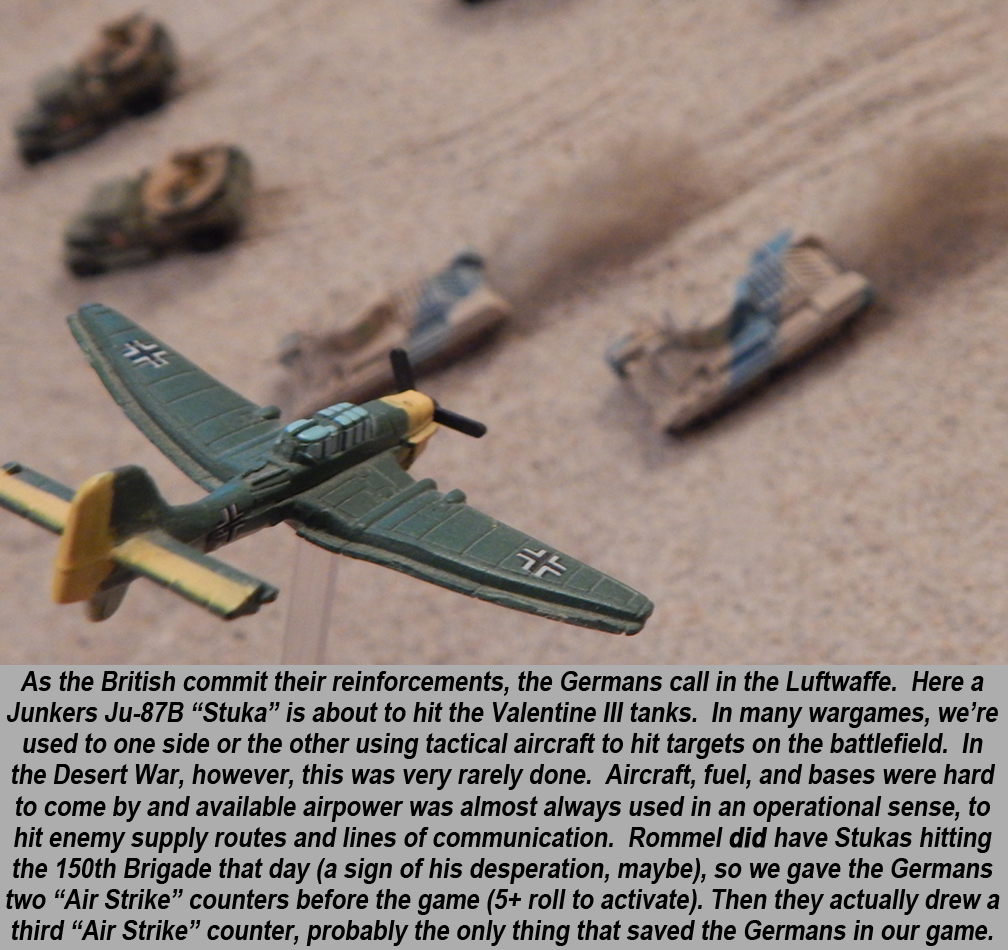
Sadly, Gazala was the end of the road for General Ludwig Crüwell, commander of the Afrika Korps. Flying over the battlefield, he was brought down by British ground fire and captured. Despite this, and learning that his wife had passed away back home, he still kept his keen wit. When brought as a prisoner back to an opulent hotel in Cairo, he cracked: “What a fine headquarters for Rommel this will make!”
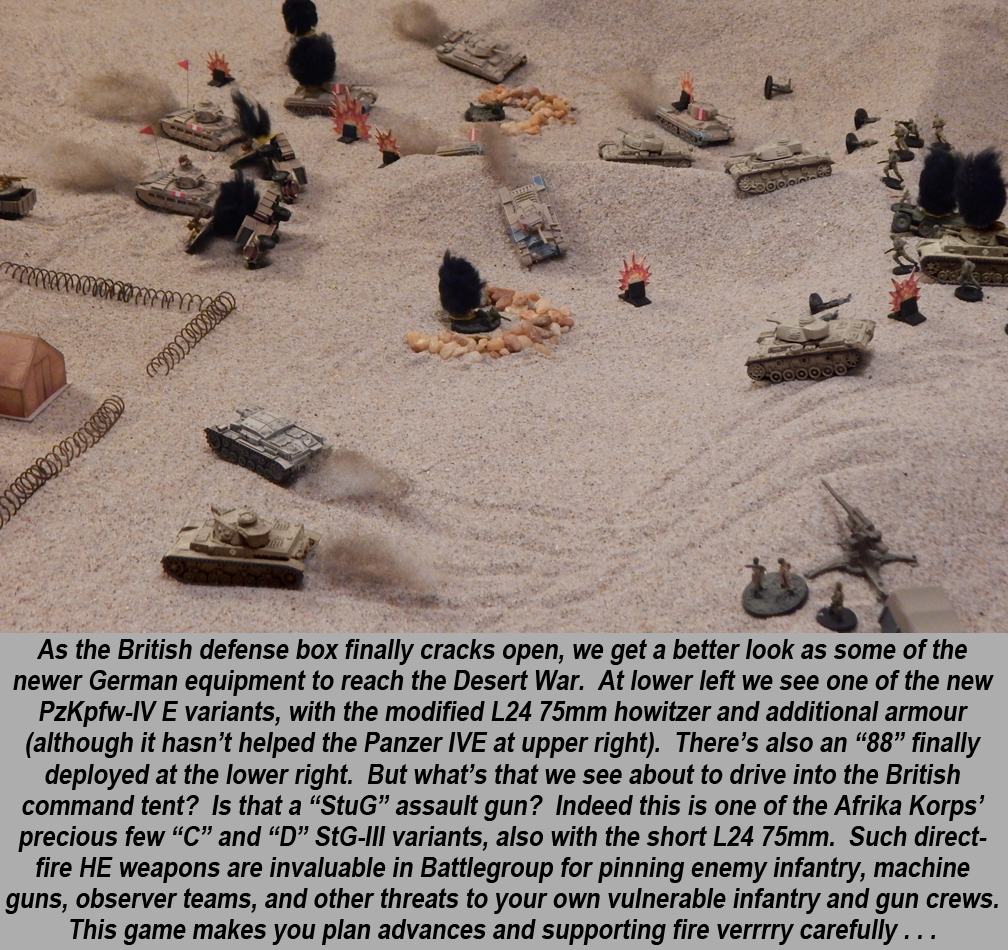
The Battle of Gazala could have easily destroyed Panzerarmee Afrika and ended Rommel’s career. Instead it was their greatest success, and wound up basically destroying the better part of Eighth Army. Tobruk fell quite easily this time, Churchill recalls it as one of the darkest personal days of the war. Hitler, meanwhile, promoted Rommel to Field Marshal, but as Rommel confessed to wife: “I wish he’d have given me another division instead.”
Now, against orders, Germany’s youngest field marshal pushed his advantage. Ignoring the vehement protests of his superiors, he re-invaded Egypt, smashing a British defence at Mersa Metruh and pushing all the way to a tiny desert railroad town called El Alamein.
He’d rolled his “risk dice” yet again and this time...he wouldn’t be getting away with it.
If you would like to write an article for Beasts of War then please contact me at [email protected] for more information!
"Rommel and Crüwell were known to disagree violently at times, but together they made a formidable team when faced with a crisis..."
Supported by (Turn Off)

Supported by (Turn Off)
"Soon it was difficult to tell who was “cutting off” who, the armies were like two wrestlers who had each other in a headlock..."
Supported by (Turn Off)









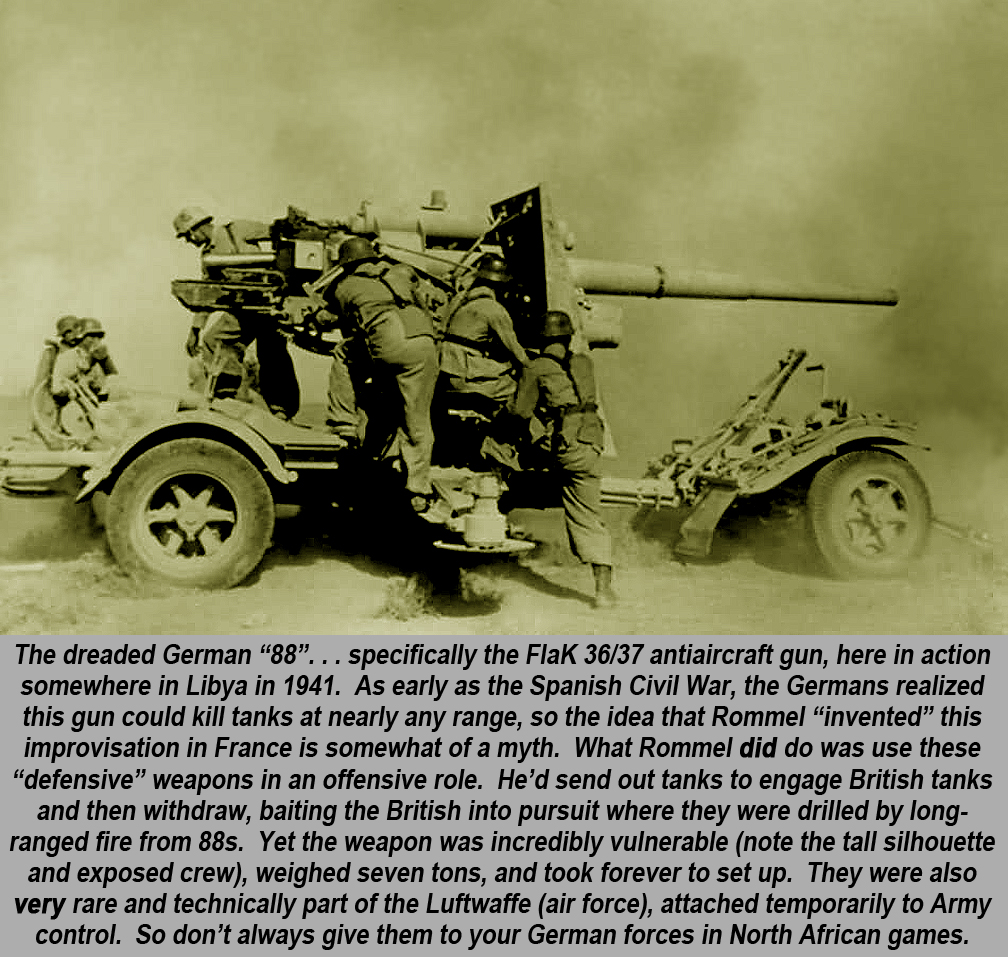
The ’88’ had the reputation but many of the tank kills were done by the handy little Pak38 50mm as it was small, easily concealed and was hard hitting enough that only Matildas stood a realistic chance and that was assuming they were no being hit from the flank. I wish I could remember the book I read maybe 25-30 years ago where some German gunners described pushing the a/t guns into good spots. They knew the British used mortars and a lot of artillery fire to try suppressing the 88’s, so having a good hidey-hole was important. The later Pak40 was too heavy to shove around but had an impressive reach.
Thanks, @dorthonion – Indeed, in the overall picture the PaK 38 5.0cm and even the little PaK 36 3.7cm antitank guns were probably more important in the early and mid desert war than the FlaK 36 “88” – simply because there are so few of them. This is part of what I was trying to address in that first caption, sometimes wargamers say: “Okay, I’m building a German force, I gotta have a Stuka, a Tiger, an 88 . . .” even those these assets were very rare and almost never fought together on the same field. I mean, if Stukas, Tigers, and 88s were as common in the real Wehrmacht as they are on today’s gaming tables . . . we’d probably all be speaking German now. 🙂
Also, even if you do have an 88 in your game, that’s pretty much guaranteed where the first British 25-pounder barrage is heading (as you say in your post). You can’t hide an 88, at least not until the purpose-built PaK 43 88 comes out much later in the war (low to the ground). As our group used to say in Panzer Leader . . . I’d rather have a stack of 75mm Pak 40s . . . than one 88mm. 🙂
…Deutsch sprechen in der Tat!
Oh, Lord no, @unclejimmy . I’ve just picked up some of these abbreviations. “Ich spreche Deutsch f***in’ NICHT!”
A really interesting part III of the series @oriskany I was not aware of all the “Crusader” operation back and forth fighting. Well, the war in the desert had been mobile, yes, but the map with the arrows going east and west looks sometimes hilarious.
On another note, what about the cruelty of some of the battles that you mention? Were there some cases that added more cruelty to the “normal” cruelty of war?
Thanks, @yavasa – I think a lot of this back-and-forth motion with the Germans was mostly Rommel trying to simultaneously respond to threats and exploit perceived opportunities with a very small but mobile force. Put more simply, he had 15th and 21st Panzer running all over the place trying to do everything at once.
With Crusader, initially the panzers were deployed to the north (nearer the coast road where all the fuel was coming in). But when the Allies struck to the south and headed for Tobruk, the panzers had to haul ass back to Sidi Rezegh to cut them off. But then the British were stopped, so the panzers hauled it back to the front to rescue the Italians they’d abandoned (Savona Division). But then the British shuffled some reserves around (New Zealanders, particularly) and soon Tobruk was again under threat, so the panzers had to race BACK to the west. The British were more or less waiting for them this time, though, so you have the collision between 15th Panzer and 7th Armoured we tried to recreate in the article.
I’ve always said, if it weren’t for the people dying in these campaigns, it really would be almost funny. You could animate the motions of the armies in a video editor, speed it up, and lay in a Benny Hill soundtrack. 🙁
In retrospect, “cruelty” might have been the wrong word on my part. “Ruthless?” “Desperate,” “Bitter?” At places like the 150th Brigade Box, Rommel’s men knew they were in a trap and had to chew their way out. The British knew they and Rommel in a trap, but if they lost, THEY would be the ones in an inescapable trap. So you had real fights to the finish with practically no prisoners taken. The famous painting at the beginning of Part One (Battle of Knightsbridge) is from this Gazala campaign, the British figure in the center of the painting is literally the LAST MAN standing. I remember when the presented a print of the painting to that same veteran many years later.
Then you have moments like Aberdeen and “Black Saturday,” when the slaughter is almost completely one-sided. The Germans have the British by the throat, yet the Germans are outnumbered (as they almost always were). They KNOW they”ll probably never get another opportunity like this, they have to knock out hundreds of Allied tanks RIGHT NOW because all too soon, hundreds more will be arriving at Alexandria.
I guess to answer your question, when BOTH armies feel they are close to a potential victory, its because they’re also both close to potential defeat. When the outcome of a battle or campaign really hangs in the balance, and it really comes down to a white-knuckled gut-check, is when you see men simply NOT giving up, which means no white flags and higher body counts. Some of the fights in “Crusader” and Gazala were very evenly pitched, and have become well-known for this “do-or-die” quality.
Thanks @oriskany I appreciate the explanation 🙂
No worries, @yavasa – thanks for the support as always. 🙂
Excellent read once again! Those games look like a ton of fun. I might be stating the obvious, but have you taken a look at issue 77 of Wargames Soldiers & Strategy? It contains an article with some ideas on playing North Africa with Battlegroup, written by Warwick Kinrade himself, good read!
Damn, I totally did not see that article, @neves1789 . I will totally check that out for the games coming up for Parts IV and V. 😀 Thanks for the heads up!
Yes, the games are a lot of fun, but my girlfriend is getting tired of all the sand scattered around the dining room. No matter how neat and careful I try to be, it’s still getting everywhere. 🙂
Hah don’t remind me of sand in the dining room! Basing my gaming boards there seemed like such a great idea at the time. (“oh the pva will just soak it all up…”)
One more big weekend of these games and I can finally take down all this stuff in my dining room. 🙂
Next up Norway? Vacuum up all the sand then break out the buckets of salt and cotton balls!
No, @koraski . . . we go for realism here. We’re gonna get one of those snow-making machines they use at ski resorts and just let it rip in my living room. 😀
ahhh! stop giving him ideas! 🙂
The tables look neat, but I gotta tell the truth I’m looking forward to getting the dining room back.
One more weekend . . . gotta get some Americans in here. 😀
It’s when it gets into the underwear and causes friction burns that it becomes a real problem 🙂
The Aussies had a good name for the Desert War – the Benghazi Handicap – because it was like a horse race in both directions, back and forth.
Very true about the sand, sir. 🙂 And definitelty a lot of back and forth. Between El Agheila and Sidi Barrani, how many times did the line swing? Three, four?
Excellent article once again.
Thank you, sir. 🙂
Bravo!! Top stuff @oriskany, always look forward to reading your articles. Hell of a theatre, really looking forward to your next entries – my old next door neighbour served in North Africa, his unit was assigned to the 7th Armoured for a time
Thanks, @bigdave . Indeed 7th Armoured had a lot of units switched in and out of its order of battle, or attached to it for specific operations, as the Desert War progressed. For this and other projects, I’ve had a great resource in the form of http://gregpanzerblitz.com/ where he lists out platoon-level orders of battle for all the divisions in the campaign, for each operation (sometimes “updating” every 4 weeks or so). So I was lucky to have a very detailed look at how the 7th Armoured kept changing and evolving over the course.
The end result seems to be that a relatively large portion of the British / Commonwealth army were veterans of the 7th Armoured, and could wear that coveted “Desert Rat” patch. 😀 (or at least, a larger portion of the army than one would expect from a single armored division).
As always a joy to read, had it not been for the real people dying on both sides
Thanks, @rasmus . Indeed, as we’re talking about panzer divisions running around like cartoon characters, and Allied formations wondering “which way did he go, George” like Elmer Fudd . . . I just wanted to make sure we don’t give the wrong impression that we’re taking the material too lightly.
Great article probably the first proper modern war? fast paced over large areas with supply’s acting like a bungee cord pulling you back or braking if you go to far as was the case with the Germans in Russia? All so you said about 88,s being reassigned for a different job stug’s were designed as infantry but the panzer units acquired them to beef up their strength.
(Support) stug’s were infantry support. -1 for being a dumm ass.
Absolutely, @zorg . . . the StG-III was originally Manstein’s brainchild I think. As early as 1936, he wanted direct battlefield artillery support that could hit individual targets in conjunction with infantry, like blockhouses, bunkers, pillboxes, that kind of thing. Some German officers resisted this, saying the early Mark IVs could do the same thing with the L24 75mm howitzer.
Great, even before the first Blitzkrieg, Manstein could predict that in practice these panzers would always be dozens or hundreds of miles ahead of the infantry, rushing though the much-lauded gaps and breakthroughs, leaving the infantry behind to do the real work of reducing these bypassed pockets of resistance.
Anyway Manstein could never get Mark IVs to stick with the infantry. And the plants turning out Mark IVs would never build an “assault gun,” they were too busy making, well . . . Mark IVs. But the Mark III was of course still being produced, so in January 1940 the first Sturmgeschütz (Assault Gun) III “A” went into production.
These were not manned by panzer crews at first, but by artillery crews. Trained solely as gunners (and not tankers), they had much higher kill rates than panzer crews on average. They did not race off ahead of the infantry, but stayed with the grenadiers and supported them at the point of heaviest contact. I think panzer crews started manning StGs later, when the Germans were running out of tanks. Also, the Waffen SS may have had a different policy here, I only say that because I know the famous Michael Wittmann served in a short-barreled StG before he got into a Tiger (one account has him engaging a Russian gunboat and possibly even a Soviet SUBMARINE in a Russian naval base somewhere on the Black Sea).
There were many versions of the StG, but only a handful every got to the Afrika Korps, definitely old the old short-barreled ones (ausf C, I think). Eventually they started “field building” their own, mounting old “sIG 33” (schwere Infanterie Geschütz model 1933) 150mm infantry guns onto the chassis of wrecked Mark IIs. Sometimes called a “Bison,” I think about 10-15 were made and I’m pretty sure they only saw action in Afrika (sIG Company 708 and 709, according to Encyclopedia of German AFVs of World War II).
Anyway, you’re very right about what happened to the StG-III line once the H and G variants came out with the longer L48 75mm antitank guns. Now they’d become tank destroyers, and the infantry lost a lot of the support they were supposed to get from the original StGs with the short-barreled, high-explosive “bunker busters.” There were replacements, like the 105mm-armed StuH-42 (Sturmhaubitze, assault howitzer), and the “Brummbär” with a 150mm. But as with so many German weapons, there were never enough, and they arrived too late.
Don’t believe everything written about Wittmann…
German kill claims were over inflated.
Yep, we’ve had this discussion on other threads. 🙂 I’m just trying to cover my ass from the “correction police” when I say assault guns were primarily crewed by artillery personnel, in case someone remembers Wittmann and throws that in my face.
Just for the record, I didn’t say anything about Wittmann’s kill record. I mentioned there are *accounts* that say this or that. Whether the accounts are to be believed is, as you say (and I agree), up to the reader.
StuGs were initially crewed by Sturmartillerie personnel who trained at the Sturmartillerie-Lehr-Abteilung in Jüterbog in 1940. They came under the Artillery Inspectorate until 1943 when they came under the Schnelle Truppe then renamed Panzertruppen.
The personnel seem mainly drawn from artillery branch initially but not exclusively.
In James Lucas’ “War on the Eastern Front” (James Lucas, 1979) the claim is made that the assault gun crews scored better kill rates than panzer crews because their artillery training focused primarily on gunnery, while in most panzer schools gunnery is just one subject of many. I can only assume they’re talking about the later F and G variants with the L48. Among many anecdotes and reports included on the topic is one of Hugo Primozic. Interesting read, especially in you’re a “StuG fan.” 🙂
as if that would happen. ?
No, you’re right, @zorg . There are no “StuG fans” on Beasts of War. 😀
There were two units that deployed StuG IIIs to North Africa.
The first was Sonderverband 288 with a platoon of three StuG III in its 5th Company[anti-tank]. In addition to the StuG IIIs the platoon also had 1 SdKfz 250/6. The unit was raised on 1 July 1941 at Potsdam and was originally designed to operate in Iraq but instead was directly assigned to Panzerarmee Akfrika where it served as a regular motorized infantry regiment. On 31 October 1942 288 was redesignated as Panzergrenadier-Regiment Afrika and completely reorganized. The StuG IIIs used by 288 were a tropical modified Ausf. C/D.
The second unit to be sent to North Africa equipped with StuG IIIs was the 1st batterie of StuG Brigade 242. StuG Brigade 242 was formed on 1 November 1942 at Jüterbog in the village of Zinna and it was intended to deploy the brigade to North Africa to support Rommel who had been requesting an assault unit to lead his infantry in attack. However at the end of October 1942 the 2nd and 3rd batteries were diverted to the southeast to Hungary and then on to Russia. However the 1st batterie was sent to fight in North Africa. It was attached to the 10. Panzer-Division as the 13. Batterie to Panzer-Artillery-Regiment 90 of the 10. Panzer-Division. It was under the command of Hauptmann Ernst Benz and it was equipped with six StuG III Ausf F/8s. Transported via rail through the Brenner Pass to Naples in Italy where they were then transferred to Siebel ferries for sea transport across to Sicily. Then marching overland to the west of Sicily they arrived at Trapani where they were losaded abord ships for transport to Tunis. During this sea transport from Sicily to North Africa the ships were attacked by allied aircraft and two of the six StuG IIIs anda SdKfz 9 and SdAnh116 trailer were lost to the sea. the battery was officially renamed to StuG Battery 90 on 30 April 1943. They also supported Fallschirm-Brigade Ramcke and then Fallschirm-Regiment Barenthin while fighting to the end in Tunisia. On 11 May 1943 the remnants of the batterie surrendered to the British at Kap Bon Peninsula.. First the captured men were interned in a British POW camp at Medjez el Bab. Then some of the batteries personnel were used by the French as forced labor. At the end of July 1943 the survivors were transported to the US and to a POW camp in Texas. In February 1946 the survivors were released and in transit to Germany they were detained in Le Havre,France and uised by the French as laborers in the lead mines in the Pyrenees until released for good at the end of December 1948.
So in total seven StuG IIIs [three Ausf CDs and 4 F/8s] fought in North Africa. No replacement assault guns were ever sent and of course all seven were lost in the fighting.
There were no StuGs allocated to the HG units in North Africa but as noted above the StuGs from the 10 PD did assist the paras in several operations in Tunisia.
Thanks for the extra detail, @piers . The first unit you mention is the one we’ve been talking about (with the short-barreled StG-III Cs and Ds). Looks like (Sonderverband 288) it was attached to 90th Light Division, at least for the Gazala battles in this article.
The other one seems to have come with Fifth Panzerarmee (10th Panzer Division as you mentions) . . . after El Alamein. My sources are much less detailed on that.
I love the writing style of these articles; Just enough actual history to set the scene and give the skirmishes weight and a frame, but not so much you get board. I especially love the invitation “Care to join us…”
That “Care to join us” was supposed to come with a “Mwa-ha-ha-ha” sound effect . . . I don’t know that audio file didn’t make it into the article . . . (just kidding, of course). 🙂
Another great Article, these are some of my favorites every week.
Awesome, @ghostbear . Thanks very much. 🙂
As with the other two parts – awesome stuff. Not even my ‘theatre’ either, but I always learn a dozen new things.
Between you and @piers who needs Google!
Thanks very much, @unclejimmy . . . and APOLOGIES . . . I just got your “Speaking German Indeed” joke up top AFTER I hit the response button. Sorry if my reply to that post doesn’t make much sense.
Of course @piers knows much more than I do. I just picked up a lot for the Desert War recently for some writing I was doing re: Panzer Leader a few years ago. We ran through the whole war, and I do mean the WHOLE war, on the battalion-regiment level in a project that took the better part of a year. The campaign journal is about 200 pages, the highlights of which are forming some of the research foundation for this somewhat smaller project.
I think you know as much as me dude. I just known random crap!
I just need access to some of your sources, sir. 😀 I’m still in mourning over the loss of some of my epic Russian online sources for Great Patriotic War. I had one site, I swear to God, that broke down every single Red Army rifle division 1938-45 (yeah, that’s 38, i.e., including the fighting vs. Japanese in Mongolia) down to the VETERINARY PLATOON that took care of the division’s horses and POST/PAY platoon that handled mail and pay . . . keeping track of all this crap as the divisions were destroyed and reformed, destroyed and reformed, new OOBs, over and over . . .
Yeah, it was all in Russian. And no, Google Translate didn’t really work because all these charts were written in “military acronym.” So yeah, I almost taught myself to read Russian.
All gone. I don’t know what the hell happened. Damn you, Putin! I was on YOUR side when it comes to 39-45! 😀
Goes to show, I guess, that old-fashioned books > internet when the chips are down.
I’m old school, books first… but that’s a collecting hobby that far surpasses what I spend on figures.
When you drop £60 on a book about just nine weeks of WW2, you know it’s bad… bloody lovely book though…
Not as bad as my book detailing all panzer division returns and supply for 43 to 45. Still not told the wife how much that cost…
That sounds awesome, @piers . Ironically, the most expensive books in my library are some of the least useful; big, colorful “coffee table” books purchased by well-meaning relatives.
I do have Peter Chamberlains and Hilary Doyle’s “Encyclopedia of German Armoured Fighting Vehicles of World War II” – which goes down to the chassis numbers of each production run of each variant. Some books by David Glantz also shine spectacular detail on the Eastern Front, and I buy a lot from Stackpole Press, as well.
I think it is far easier to justify spending money on books, to most people, than on “little plastic toys”. So you go right on buying books @ piers, it returns my faith in humanity that we are actually still buying and reading paper page books.
The teacher has spoken. 😀 The O-O-O-NE thing I like about e-books is some kind of search functionality. I know “real” books have an index (you hope), but many times those are rubbish. If you’re trying to write something semi-serious you’re constantly checking on things (even if its only the spelling), and being able to find specific information very quickly is a big help (especially if you have fifty or a hundred “books” in your backpack).
the battery’s don’t flat in a book.
the battery’s don’t go flat in a book. my head is’nt working today.
Yeah, but you can’t but copy/paste out of a book! Just kidding. 🙂
Remember folks, when you steal from one writer, it’s plagiarism.
When you steal from many . . . it’s RESEARCH. 😐
That is a great point @dorthonion. A lot of modern historians do not describe the sword and shield tactic as deployed by Rommel fully. The AT guns were deployed in a long wide V formation. Just a handle full of 88s form the apex, then along each leg of the V the 37mm were generally deployed near the 88s with the 50s deployed towards the end of each leg. He then used his tanks to lure the allied tanks into this AT box with the 37s and 50s hitting the allied tanks on there flank and usually accounting for more kills than the 88s. It still a great example of effective planned fields of fire.
I think this demonstrates Churchill at his lowest. He fires Wavell and others over a mess he created. At the same time he was asking the King and parliament to accept his resignation as prime minister so he could take command of the Western desert forces personally to he could deal will this Rommel chap.
Technically Tobruk is a siege. There are a number of examples of sieges of fortified towns and castles that still had access to the sea. As far as us Australians were concerned it was just like the WW1 Western front, just very semi-circular. As “Ming the Merciless” Morshead said “Tobruk is not here to take it. Tiburon is hear to give it”. We were going to own no-man’s land with a very active defence. It is here that Australian artillery doctrine was created. Most armies will drop artillery on their own position but depending on the army final protective fire only comes in as close as 200 to 400 yards. So assaulting units tend to rush in as fast as possible to get within this zone under final protective fire. We were able to get the British to bring their final protective fire from the 25lbers down to just 50 yards where the enemy was trying to form up for the assault. To their credit the British deployed their forward observers right up in the forward positions. But don’t get me wrong. The Germans gave as good as they got from us and gave us plenty bloody noses for our troubled.
Full agreement @piers I think we are all masters of random knowledge here. Tell you what don’t tell my wife what I paid for German Panzers in Finland either, truly a great book. 🙂
@gladesrunner in that case I will not suggest Finland in fall to @oriskany, all those birch trees, all those tiny yellow leave falling in the wind. 🙂
Wow, @jamesevans140 – I had never heard that about Churchill wanting to take command of the Western Desert. What a fiasco that would have been. I’d heard about him wanting to go in on the D-Day beaches with the first wave, it wasn’t until King George VI supposedly suggested that he match the move that Churchill finally backed down on that idea.
Like @johnlyons says, history remembers the insane people. 🙂
Have no fear, though . . . I WILL do Finland one of the days, probably soon rather than later, although it will probably be on a Panzer Leader board. This “miniatures” thing is a lot of freakin’ work! 😀
Totally blown away @oriskany . Well done!
Thanks for the kind words, sir. 😀