



































Basics Of Kickstarter Part One: What Is A Kickstarter & How Does It Work?
May 6, 2015 by crew

Hello, My name is Maledrakh. And I am a Kickstarterholic...
Well, it is not really a problem, I can stop any time I like. Really. Today I have only logged in once...maybe twice. I have seen Kickstarters all the way from massive successes to utter failures, been rewarded with my body weight in new games and miniatures, and seen some of my pledge money disappear faster than a lone Goblin Shaman in front of a gunline of Thunderers. All in the last few years...
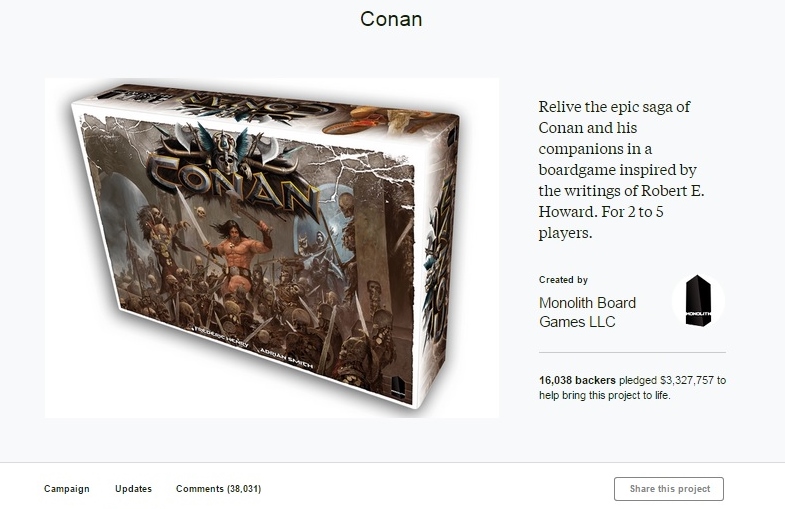
Crowdfunding (aka Kickstarters) has rapidly become omnipresent on the internet. Kickstarter campaigns have funded a lot of new games and miniatures, (and computer games, movies, wallets, gadgets, potato salads, art books, music performances, you name it) in many cases raising anywhere from hundreds to thousands, to hundreds of thousands of dollars for the creators. Of course, when this kind of money can be had, some bad people turn their envious eyes upon crowdfunding, to slowly and surely draw their plans against it, bending all their will towards how to get a piece of that sweet, sweet action!
We need to acknowledge that the world turns. Crowdfunding is here to stay for good and for bad, and is something that we as gaming hobbyist consumers will need to at least know something about. In this series of articles I will be getting rather wordy about crowdfunding game and miniatures related projects through Kickstarter and similar sites. We'll discuss what Kickstarters are and what they are not then most importantly of all; what we as backers should be aware of and take into consideration before taking the plunge and backing a crowdfunding campaign.
Kickstarters Everywhere! What Is That All About?
If you have not heard the term Kickstarter by now, you must have been living without an internet connection these last few years. But what is a Kickstarter really?
As it turns out, it is several things...
1. The Word!
Kickstarter.com is by far the largest of the crowfunding sites, and as such the word Kickstarter, or KS for short, has become a term that really means "project on a crowdfunding website". For example, a creator "does a Kickstarter" and "Kickstarters a game". One of the more common questions game companies get when talking about a new line, is "when will you Kickstarter it?".
For many backers, "Kickstartering" (backing crowdfunding campaigns and being active in the communities that spring to life in the comments sections of said campaigns) has become a major pasttime, even a hobby in itself. Not in any way an addiction. I can stop anytime I want. Sure I can.
2. The Sites!
Kickstarter.com and other crowdfunding sites such as indiegogo.com have revolutionized how stuff gets made, or rather: paid for. Many game-related projects have managed to get hundreds of thousands of dollars in funding (some have even surpassed the million dollar mark, a few have made over three million!), and have added oodles of new games and big, giant heaps of plastic and metal crack to many hobbyists' collections and retail store shelves across the world. All by the magic of getting many smallish contributions from a lot of people!
3. The Funding!
In the olden days, someone who wanted to make a game and/or miniatures, would have to fund it through the traditional means: such as bank loans, nest egg savings and scratch card lotteries. Then, often in massive debt, they would have to gamble on whether the public buys enough of their game to make the money back, usually without having enough funds to launch and market the game properly, ensuring its early demise and personal bankruptcy.
In addition with the current economy, banks are not very forthcoming in giving loans to anyone with big dreams but no proven track record to speak of.
Now, almost anyone (creators) can present their dream as a campaign (projects) on kickstarter.com or other crowdfunding site, and ask the general public (backers) for money (pledges) to be able to make it.
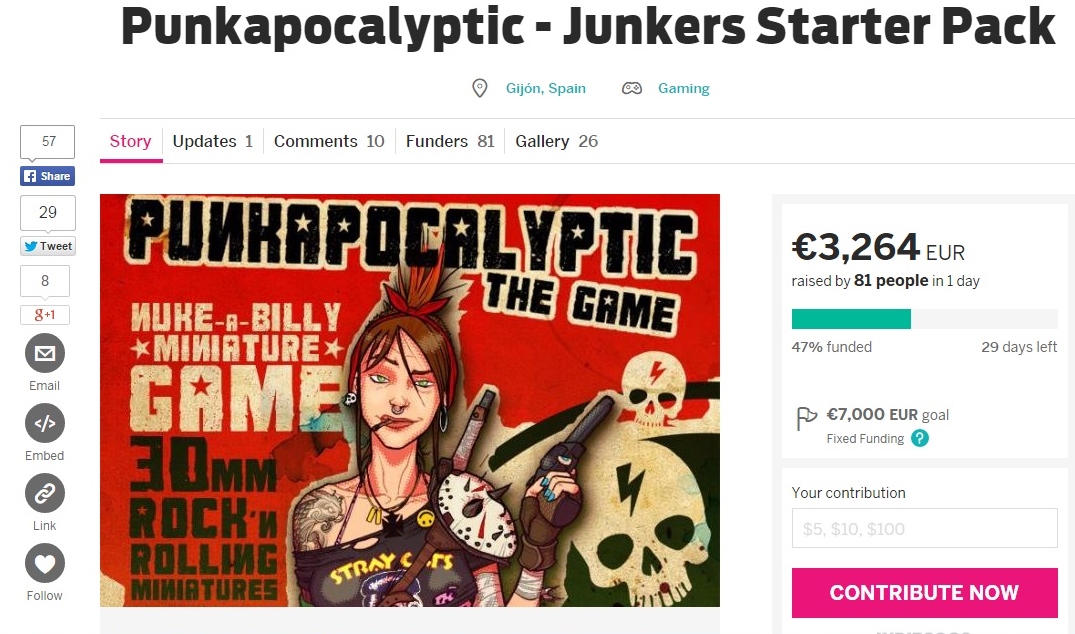
Those who choose to back the project pledge some manageable amount of money towards it and in return are promised some sort of rewards such as a copy of the game, a set of the miniatures, or whatever, depending on what the project is for. If the project reaches its minimum target level to be funded (known as a funding goal) the money is collected from the backers and most of it is given to the creator . If the funding goal is not reached, no money is collected*.

If the target is surpassed it is common for additional funding goals (known as stretch goals) to be offered. Such stretch goals usually say, "if X amount of funding is reached, we will add Y to the rewards". Some such stretch rewards are free for all pledgers, some are so-called add-ons that need extra payment (known as increasing the pledge), further adding to the funds the creators get.
Basically, many people contribute some amount, typically in the range of 10-100 dollars to a given project. Of course, if you want everything that is to be made for a given game, especially if that game has hit many stretch goals, you might end up pledging more than a thousand.
This way, the creators can not only get their dream funded before it is made, but also gauge if the public actually wants to buy what is on offer! Win win!
Of course, this is quite a big risk to take, as there are NO GUARANTEES that anything will come of it, in which case, kiss your hard-earned mula goodbye! Consumers beware!
*some sites have alternate funding systems, such as indiegogo.com's flexible funding, which collects the money as soon as it is pledged. You might want to check this before pledging.
4. The Power! The Passion!
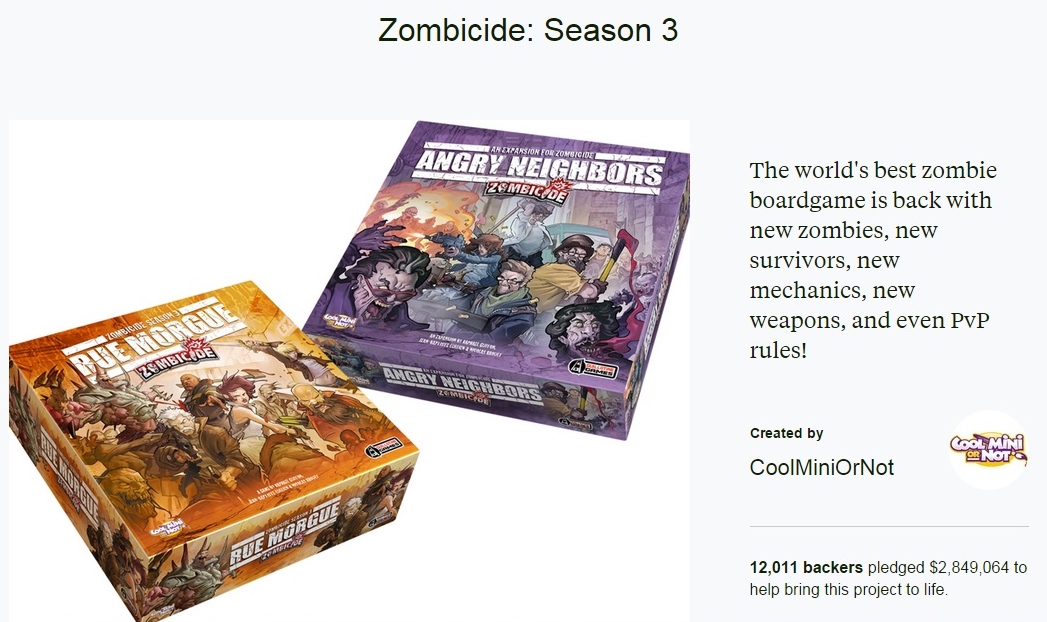
Kickstarter is above all, a massively powerful marketing tool for a budding miniatures or game company. Some companies have even managed to make Kickstarting an integral part of their business model, with great and repeated success, engaging with their communities to create a massive positive buzz! (In some cases, a massive negative buzz as well!)
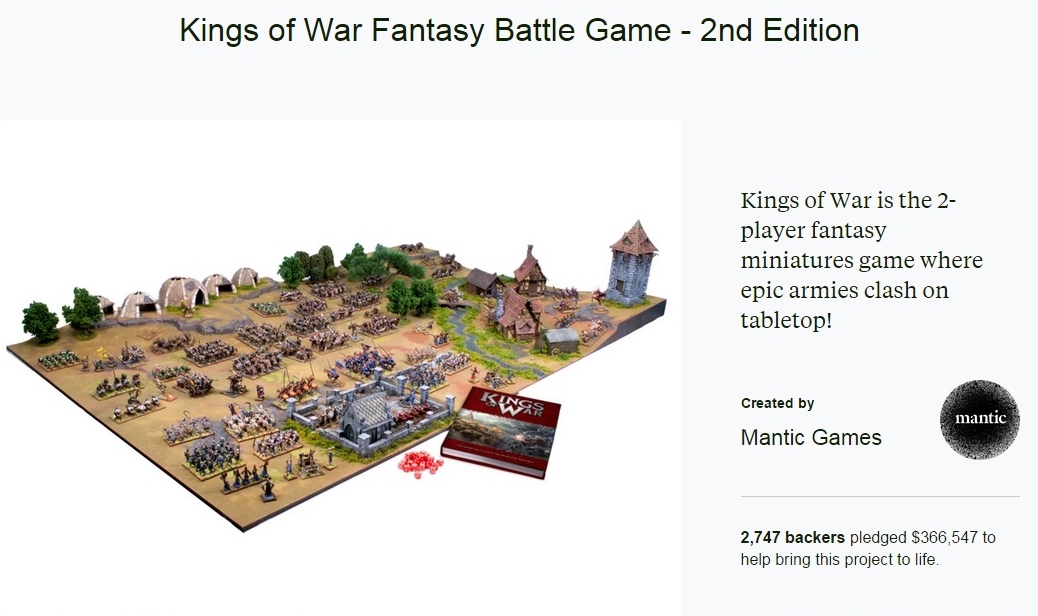
Others have seen, shall we say, too much success. Leading to spectacular failures! Of course, with such great power comes...well, not really any great amount of responsibility at all!
Kickstarter is something quite new in many ways and the world as a whole has not entirely come to grips with it yet. Consumer regulations do not quite cover it. We are all still in the process of figuring it out, and adapting to this new contender for our money. I am certain that we in the forseeable future will see changes to how things work, and that legislators around the world will try to regulate the phenomenon.
This is one of the things we will be looking at in the next installment in this series: The Joys of Backing, or What Kickstarter is Not!
If you would like to write articles for Beasts of War then please contact us at [email protected] for more information!
"We need to acknowledge that the world turns. Crowdfunding is here to stay for good and for bad..."
Supported by (Turn Off)

Supported by (Turn Off)
"Some companies have even managed to make Kickstarting an integral part of their business model with great and repeated success..."
Supported by (Turn Off)









A great idea and an eyeopener for those people who may come across this and not know the pitfalls. We are building towards a kickstarter release next year so for us it is an integral tool allowing us to bring out our own gaming system and throw our hat into the wargaming arena. Without Kickstarter I imagine it would have took us a long time to put the necessary funds together after which we still wouldn’t really have been able to gauge the interest. I look forward to your future articles.
I have backed a few kickstarters, my 1 piece of advice is research as best you can the company doing it, as when a kickstarter goes south, you are boned (I still feel really sorry for anyone who backed the defiance games kickstarter)
With Kickstarter some advice i wish i had got before it started sucking my hobby money out of me. Always check out the company if you can if they have a previous kickstarter project check the comments and the updates to see how thing are going. Also check there Facebook page any project worth its salt should have one these days.
Remember you like the look of this project now but you might not be getting for another year at least try to think ahead will you still like it when you get it then i know that might be hard because you just need that new shinny bit of plastic.
Check the exchange rates especially if your in main land Europe you might stung with something costing a lot more than you originally thought. Also find out how your new toys are going to be shipped and were there coming from as a big expensive parcel from countries can lead to an extra charge but shipping within the EU will not.
Hope this helps anyone else jumping on the back of the Kickstarter Beast.
to me the most important thing is to realize that kickstarters are not preorders. its an investment in an idea, hopefully something good will come of it, and you get your moneys worth. But you knewer know. And be prepared for delivery to run late. All dates are estimates and from my expirience they tend to be best case dates… its rarely best case happens for kickstarter.
That said big kickstarter companies like coolmini or mantic are less risk and more preorder. they have done it many times and seem to know what they are doing. 🙂
Ive spend way to much money on kickstarter and have no real regrets so far.. other than the waiting 🙂
thx – good read – hope for more.
Good article, looking forward to more
Pretty good article. I’ve supported quite a few kickstarters and I haven’t been burned yet. Yes there have been delays. I’m patient and I realize that things happen that delay things all the time like the west coast dock workers work slow down or Chinese new year.
It is interesting that like anywhere there are people who comment in a kickstarters comments just to troll. In fact I’ve seen people pledge then comment why they weren’t going to pledge (because the only way you can comment is to pledge). To me that always seemed like such a waste of time.
I’ve backed 6 or 7 kickstarters over the last 2 or 3 years. The one rule I always follow is I never back anything being made by people that haven’t shipped a previous product of which I am familiar AND which was well received by the public in my view.
I mainly look for established “old guys”, like Mark Jacobs, Jordan Weisman or Chris Roberts that have made games I’ve enjoyed in the past but that want to skirt around traditional publishers in order to make the game they want, and not what a publisher wants.
Also just realized I have never backed a miniatures kickstarter. I’ve watched a few friends do it and as Reaper world headquarters is a 5 minute drive from my house I’ve watched them go through their Bones kickstarters. I guess I just don’t have a real need for all those miniatures as I know I will never get around to painting them.
This is a very interesting topic, so thanks for starting it. I’ve not yet pledged anything via crowd funding as I tend to be risk averse but as an approach to raising the funds to launch, it certainly makes a lot of sense for any company. I hope it continues to grow.
Out of interest, have some projects launched across a number of different sites to increase their coverage or do they stick to just one site per project?
I have yet to see any project run simultaneously on several sites. apart from a case of identity theft where scammers copied a comic book project and ran it on another site more or less at the same time without the knowledge of the actual creator. This was discovered and shut down.
I know of at least one miniatures project that first failed at indiegogo and then funded on kickstarter. (and then later failed / non-delivery because of reasons to do with the creator)
I think the considerable non-stop stress of running a campaign would be too much if you ran several at once.
kickstarter is really fantastic resource for companies to get new games made 🙂
like the article says, it’s very difficult to get traditional funding ( like bank loans )
so it’s an amazing way to get minis and games to the people who want to buy them 🙂
and also, it helps soooo much with advertising the game 🙂
because in previous times it would take years to build up a fan base,
but now a game can release with a core group of players and gaming groups 🙂
and it also allows for some extra creativity, which is why you see a lot of wargame / boardgame hybrids 🙂
it’s been a huge boost of energy into the gaming genre as a whole 🙂
the only thing I would say is, just like the article says, research is very important 🙂
not just for backers, but also the new companies planning on launching their own kickstarters 🙂
find out what can be achieved with different manufacturing processes, shipping rates, etc,
and keep the stretch goals sensible 🙂
we all like extra shiny things, but extra shiny things can cost a lot to make 😛 ha ha
we all want the games to be successful, so it’s best to get the most important elements made first 😉
the stretch goals can come later 😉 and they are fantastic too 🙂
new minis and even full expansions that would have previously taken years to come out,
can now be funded much quicker 🙂
it really is amazing what crowd funding in general has done for the industry 🙂
but I still think there needs to be much more done to include independent game stores 🙂
some kickstarters have started to do things right, but there’s still room for improvements 🙂
more store focused pledge levels with stock price discounts for game stores 🙂
and I really approve of the way some allow people to pledge via local game stores 🙂
hopefully this trend will continue to grow 😀
A great article, @maledrakh . I’ve always been leery of Kickstarters, but your article puts it into balanced perspective by allaying *some* fears and clearing up *some* misconceptions . . . while letting me know that some of these pitfalls are also real and I wasn’t just being crazy or paranoid. 😀 Great writing, and great balance.
thank you @oriskany! High praise indeed, coming from you!
I would think very carefully about backing any KickStarter projects. Your pledge money could see you out of pocket and with nothing to show for your investment. I pledge over $1200 on the Dust Project Babylon KickStarter in June 2014 and almost a year later I’ve received nothing from BattleFront with little chance of getting my money back.
Welcome to the club, I pledged $1500 and all I got was the rulebook, the US box, a template and some cards… I’ll drop that kind of money in any KS project again.
I am one of the lucky ones then, since I got the bulk of my DUST pledge delivered before this problem surfaced Still missing all the special characters and freebies. The DUST debacle just goes to prove that even well-reputed established companies can fail to deliver.
If you believe they will not be delivering at all, you might try a cash-back claim through your credit card provider, due to non.delivery of paid goods. It will probably be refused by the CC company due to time limits, but it’s still worth a shot. Stranger things have happened.
“If you believe they will not be delivering at all, you might try a cash-back claim through your credit card provider, due to non.delivery of paid goods. It will probably be refused by the CC company due to time limits, but it’s still worth a shot. Stranger things have happened.”
But that’s the issue. There’s no nondelivery, no customer, and no goods. You’re much closer to being an investor than a customer.
True, the owners promise to give you some freebies if the project comes through, but you’re not, strictly speaking, buying anything.
Personally, I’m simply waiting for the big one – the big scandal that gets lawyers involved. Then perhaps, we can finally get a judgment on exactly where Kickstarter stands.
But until then… Buyer beware…
i know anything by mantic games is well worth backing and the new KoW rules have my full support!
BoW does its upmost to tell you whats going on and to get the guys in on a show so good work guys!
Of companies I have backed over several KSers I have found Mantic, Reaper and Oathsworn to be consistently good, communicating well and delivering the goods. And learning from mistakes, getting better with each KS.
I would not hesitate to pledge for projects by these companies again.
And, dare I say it for fear of getting shouted down, I also only have good experiences with CMON, including their customer service when requesting replacement parts for damaged minis.But then I did not back any of the chibli-style sames that have caused the most nerdrage.
My Mantic experience is Dreadball Xtreme. I have to say the comms have been pretty bad post-campaign and you can read the comments to see that there are some unhappy backers for several months now; looks like they might be spreading themselves too thinly with all the recent Kickstarter activity. Don’t get me wrong, I think Mantic are one of the safest bets on KS and I have absolute confidence they will deliver everything…eventually. Just think it’s worth giving a more balanced view for anyone getting into this for the first time so their expectations of the whole experience are more realistic.
I’ve been burned by a few campaigns, so I’m more careful over on what projects I back. Even then I still find myself having to muster up all my willpower to keep myself from backing too many campaigns.
I know my opinion on this isn’t popular,I know sites like KS and Indiegogo have changed how business can be done, that’s fine. I’m seeing KS used as a storefront for pre-orders more often and in some cases used that way time and time again by same company/individual. Which made me ask how acceptable is it for a company to continually use these sites to fund entire franchises or properties? That well will eventually run dry. And as long as a campaign doesn’t break any of the site’s guidelines, what’s to stop much larger/well established companies (Topps I’m looking at you), or even large corporations from using the crowdfunding platform? I have a large number of local gamers who were once hardcore supporters and backers of all things Cool Mini but are now completely turned off by them because of how many times they have stuck their toes in that pool.
hmmm, I see what you mean to a degree, but remember Cool Mini is not a single publisher,
it is normally several different game creators that team up with Cool Mini
mostly to help promote the game and get help with manufacturing and other things
publishing a big box game is very expensive, especially in plastic, so some smaller companies collaborate with them 🙂
and when it costs sometimes hundreds of thousands of dollars just to make the plastic molds for a box game…
then yeah, small companies can’t get loans from the bank like that 😛 ha ha
that’s why kickstarter is such a good platform 🙂
contrary to popular belief … you don’t make lots of money in this industry 😛
people aren’t swimming around in money pits like Scrooge McDuck 😛 ha ha ha
Actually CMON is extactly that: a publisher. However, they do not make any of the games. Independent games studios do that, and leave the marketing and running of the KS to CMON. This is not too different from what happens in computer games production.
@greggieo:
It is only natural that some customers are “saturated” after a time, CMON is much more akin to Electronic Arts than to say Games Workshop or even Fantasy Flight Games. Their entire business model is built on launching new KSes every other month or so.
The market is constantly evolving and customers come and go. You cannot ever make every one happy all the time.
… errr … that’s exactly what I just said
Sorry about that, I thought I was replying to Greggieo,
and again I reply slightly too fast ;/ What I meant in my original reply there was to point out that CMON is ONLY a publisher. Which of course is pretty much what you said @motioninpoetry. Sorry again.
So what ever happened to the Heroquest 25th anyway?? It looked good but I wasn’t going to touch that with a 20 foot pole.
The Heroquest on Kickstarter got locked up by a copyright claim from some third-party US-based company that claimed they owned the copyright in the USA and wanted money. Gamezone pulled out of KS after that, feeling that KS did not treat them right. The campaign was launched some time later on lanzanos.com, a Spanish crowdfunding site, where it funded with 12000 backers and 680000 euros. I believe it still is in production. At least I have not heard anything else. I did not back the lanzanos-campaign, as it did seem too risky at the time. This is one project I will be glad to see delivered.
I believe the company doing the KS only had copyright clearance within Spain which caused all the problems.
The thing is that the main Heroquest-copyright is considered to be abandoned, Therefore there are no longer any copyright claims on it, at least according to spanish / european law. Which is why Gamezone could pick it up and run with it. GW still has asserted copyright to some of the images and models, which is why it cannot be a carbon copy of the original game, and more of a “re-imagining”.
A Good article, I would say that any backer needs lots of patience as any number of delays can extend the expected date by months. Also it’s best to use a credit card as the UK Consumer Credit Act gives additional protection if goods and services are not forthcoming once your efforts with the retailer to obtain a refund have failed. The card company would recompense you and then go after the company themselves.
There is normally a time limit for your claim however. And in most cases where you’re likely to want to use this facility, you’d be over the limit. Apart from outright scams, the time you’re most likely to need to claim is if a creator spends the money on a project and runs out before completion, or hits an unexpected hurdle (such as illness) meaning that they can no longer deliver. And this is likely to take some time to become apparent.
So worth considering your CC protection, but probably best not to assume it will help you.
Good article, thanks.
1) delays are inevitable with most KS, just chill as long as the comms keep coming.
2) avoid anyone who states there is little or no risk.
3) check comments etc on any previous projects run by same people, look for patterns.
4) mind the shiny syndrome, don’t pledge moire than you can afford to
– spend
– store
– paint
– play
Thank you all for your comments! I am happy my first (ever) article has been so well received!
The next part deals with a many of the issues several of you mention, and the one after that will deal with more solid advice for what you might want to check and be aware of, red flags and such.
I started about a year ago and generally have had positive experiences (although I also backed the DUST Babylon KS). My advice is pledge small and don’t get carried away. The base pledges are often awesome value, but that decreases (and your risk increases) as you start including all the add-ons.
I would also say if anything smells a bit fishy, get out of there. I thought the DUST campaign was pretty sound, established companies in an existing partnership essentially doing a quick turnaround pre-order so they could release the range quicker rather than drip feeding it out. However, during the DUST campaign, someone posted a comment to the effect that Battlefront’s balance book was not looking too great and there might be ulterior motives to them raising funds. Battlefront’s response to this post was just a little bit too quick and weird (saying how they made more money in one month from a board game than they did from DUST in a whole year and they were really only doing the KS as a favour to Dust Studios).
I have no idea what their books look like, but we do now know that they had outstanding debts to Dust Studios prior to the KS and that both parties were complicit in this and aware that they had written a contract to say this would be paid using some of the KS funds, which is actually a breach of Kickstarter rules! If only I had followed the fishy rule!
Good article. I have backed 15 Kickstarters over the last 2 years and all has been well, with the exception of Aliens vs Predator which is a year late, but due any day now.
Everyone should use Kickstarter/indiegogo. You get a really great deal and literally ensure your favourite games get produced. Plus the more people who back, the better deal everyone gets.
My only advice is “don’t pledge more than you can afford to lose”. Some kickstarters go south and you will lose the shirt off your back, if that is what you pledged. $1500 on Dust?? I hope you don’t lose your house.
I have often looked at and wondered WHY? kickstarters, I understand what is to me the real way of financing a project and that would be through both personal and bank backed funding. I would like to ask three questions please.
Given the option would a start up company prefer to be funded by kickstarter or by “the old fashioned funding.” (Sorry if calling it that is not actual bias I don’t know what is when the article goes on to make kickstarter sound as being new, fresh, modern easier approach.)
Second, I am not against kickstarters but what I would like to see is some sort of self legislating set of rules that those companies using kickstarters are more held to check and then the risk would not be in the sole place of the members funding the kickstarter.
Third the gaming bankers fund, one of the old fashioned financial houses has a pact which is to the have an system where moneys are placed in check and released in an old fashioned staged release as each release comes to the market.
Or another fairy tale approach would be how many wargamer’s are there in the country counting everything including the likes GW. Then on a voluntary basis all those gamers gave
a nominal sum into an account at the said old fashioned banks to be ring fenced for such use of the kickstarter. It sounds far stretched but is it, the kickstarters have to pitch for the funds from the holders of the finances and then the funding is not a major risk to those who are indeed the gamers.
Having started my own terrain making company (6 months ago), we are definately looking at what Kickstarter can offer for us. In terms of sales its, more efficient to sell things through Kickstarter than via EBay (due to the fees taken). But obviously there is a risk at completely damaging your reputation in doing so or just messing up (from the buisness end). So a lot more work and planning has to go through in the process.
We are definately looking at expanding our buisness in this way perhaps offering dicounted ‘pack sets’ of our terrain in return for funding of different levels – this will then give us the finances to not only fund the items produced for backers, but also give us money to invest in a future direction (perhaps outsourcing some of the production etc…)
Again from our own viewpoint of a business it offers brilliant terms as we gain the funds to produce a project without all of the extra expenses of loans etc… (just 8-10% fee from the funding – this saving then enables buisnesses such as our own to give that saving back to the customer in terms of product in a situation whereby the company wins as they sell more product, the customer wins as they get more product and Kickstarter wins as they make a percentage).
Anyway more from this in the future!!!
All the best
Sean
http://www.reddragongaming.co.uk
If you do go to KS, be prepared for nightmare backers, these are the people who, for whatever reason, have completely unrealistic expectations around different aspects of the project. The best way to deal with this is to be as open and upfront as possible, during and post-campaign. If you think you can only guarantee an update once a month, say that at the start. Any problems/delays/setbacks let the backers know sooner rather than later. Waiting until your estimated delivery time to tell people things are going to be 6 months late or just dodging the question doesn’t help anyone. Generally under promise and over deliver is a winning combination, but surprising how many companies, even the big ones, keep doing the opposite!
The other big one is delivery charges. They have been spiralling and the cost in a years time, when you deliver, may be much more than when you collected the money for it. I have seen this kill or nearly kill many KS’s.
Not sure what you mean about being cheaper than eBay though as I thought KS skim 10% off the top and there are probably charges for the money handling side, so I would have thought the two would end up quite similar.
Best of luck with your new venture.
Disclosure: The above is just a backer’s view on all of this. I have never run a KS!
Some facts from someone who’s been there (I’ve run 6 of KS’s now…4 of which were 500% over-goal…2 of which failed miserably):
* Kickstarter takes 5%, the credit card companies take anywhere between 2% and 5%.
* Assuming that you’ll lose 10% of your pledges is a ‘safe’ bet…but 8% is probably what you’ll wind up paying.
* For my Kickstarters we ended up spending around 20% of our pledge money on shipping costs…but that’ll depend a lot on whether you’re selling custom-engraved anvils or PDF files! Shipping rates do change over time…so you might want to budget 30% rather than 20.
* Openness and frequent communication is *VITAL*. Never, ever, say “We’ve been too busy to do an update” – it only takes 10 minutes to type a couple of paragraphs about what you’re so busy doing. Your backers know this – so if you don’t do regular updates, they’ll assume that you’ve taken their money and spent it all on a wild party. Once you lose the complete and utter faith of your backers, you’re doomed…and bad news travels fast so one screwed up KS will lock you out of the game forever.
I must admit my impression was always that it was a way to kick start a company or project that would then become self funding from that.
As a Backer:
* Backing a business with zero track record is a gamble – don’t bet more than you can afford to lose.
* When it says “Estimated delivery” in the reward description – notice the word “ESTIMATED” – don’t whine about horribly late delivery unless they are more than a few months overdue…and even then, if there are good and valid reasons expressed in frequent updates, expect to need some patience.
* You can generally pledge $1 for no reward and enter into a conversation about the product and generally get comfortable with the project owner before upping your pledge to get something you want.
* Take the opportunity to chat with the maker(s) of products you like. Tell them how you’d like it to be different/better – tell them what you’d like them to do next…if there’s something you really want, there is a good chance you can actually get it made for you.
For Project owners:
* Be open…tell your backers everything about your business, how you make stuff, how you are progressing on producing the rewards. It’s hard to get used to being that open…your competitors will probably be $1 backers…but that’s the price of doing business in this space.
* REGULAR UPDATES…I can’t stress this enough. Expect to put out an update every few days during the campaign – and continue to put out fresh updates every two weeks until the very last reward is shipped. *NOTHING* spells disaster more than poor communication.
* Answer every single backer’s question – every email, every comment. Be responsive to their needs where you can – but when you can’t do what they want, explain why you can’t – don’t sign up to do things that are unrealistic for your business.
* In project planning, make at least three plans: “What do I do if we only *just* make goal?”, “What do I do if we go 5x over goal?”, “What do I do if we go viral and earn a million dollars?”…you need to think about how you’ll manufacture and ship in all three scenarios. You can’t package 10,000 rewards in your back bedroom…and you can’t afford to pay someone to package as few as 100 rewards. You might be able to resin-cast 100 models by hand – but you’ll never manage 100,000 without leasing factory space and employing workers to help.
For everyone:
* Have fun!
Always assume fulfillment will be late, especially when the funding far outstrips the initial goal, and/or production is in China.
Others have mentioned checking comments on previous campaigns if it is not a brand-new venture. I would add to never back anything that hasn’t already fulfilled at least the majority of its pledged rewards from its last campaign. I was fortunate to get my modest rewards from Center Stage Miniatures before they went completely dead.